
By the end of 2026, online sales will account for 25% of all diamond jewelry transactions globally. If you’re still managing your inventory through disconnected spreadsheets, you’re not just losing time; you’re losing market share. Effective jewelry product information management for retailers has shifted from a back-office luxury to a core operational requirement. With the global jewelry market projected to reach $254.13 billion this year, the margin for error in gemstone specs or fluctuating gold rates has effectively vanished.
You know the frustration of updating a single diamond’s price across Amazon, Etsy, and Shopify only to realize a typo in the carat weight. We understand that jewelry data is uniquely complex, requiring a level of precision that general e-commerce tools simply can’t provide. This guide promises to show you how to centralize your gemstone data, automate multi-channel listings, and maintain a single source of truth for your entire brand. We’ll explore how to handle the new July 2026 CPSC eFiling requirements and leverage automated gold feed syncs to scale your retail operations with absolute confidence.
Key Takeaways
- Understand the “Complexity Tax” and why managing intricate gemstone specs like carats and clarity requires a specialized digital infrastructure.
- Discover how jewelry product information management for retailers transforms raw ERP data into rich, marketing-ready content across all your sales channels.
- Learn why standard ERP systems fall short in multi-channel environments and how a PIM acts as the central engine for your global listing automation.
- Master a 2026 data strategy by auditing your current catalog and normalizing attributes like metal purity and hallmark standards for consistency.
- Identify how a jewelry-specific “Source of Truth” eliminates manual data entry errors and accelerates your time-to-market for new collections.
The Jewelry Data Crisis: Why Retailers Need a PIM in 2026
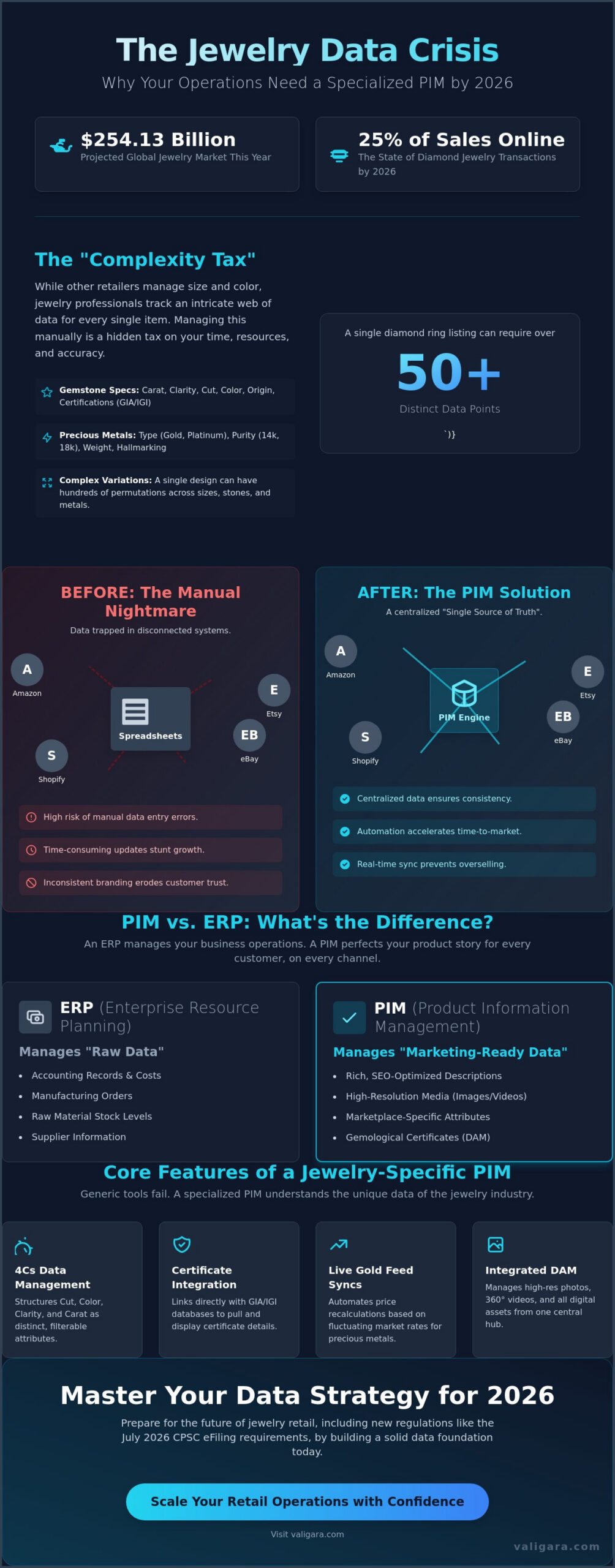
The modern jewelry trade operates on a “Complexity Tax” that few other retail sectors face. While a clothing brand might manage simple size and color variations, a jewelry professional must track carats, clarity, cut, metal weight, hallmarking, and origin for every single piece. This intricate web of data is exactly why jewelry product information management for retailers has become the central engine of successful 2026 operations. If your data is trapped in disconnected spreadsheets, you’re paying this tax every day in lost time and manual errors.
Generic software often fails because it treats a diamond ring like a generic SKU. It lacks the specialized fields needed for gemological certifications or live gold market fluctuations. To understand the broader context, What is Product Information Management (PIM)? It’s the centralized process of managing data for multi-channel distribution. In our industry, it’s the difference between a professional global enterprise and a struggling manual seller. When your workshop, warehouse, and online storefront operate in silos, the result is inconsistent product descriptions that erode consumer trust in high-ticket luxury items.
The Anatomy of a Jewelry SKU
A single diamond ring listing can require over 50 distinct data points to satisfy both search algorithms and high-net-worth buyers. Variations in jewelry are fundamentally more complex than in apparel or electronics. A single design might be available in three metal types, five ring sizes, and four different center stone qualities. Managing these permutations manually is a recipe for disaster. A jewelry-specific PIM centralizes high-resolution media, GIA certificates, and 360-degree videos, ensuring that every variation is presented with technical precision and visual elegance across your entire digital footprint.
The Multi-Channel Challenge
Scaling your brand means appearing where your customers shop, but every marketplace has its own rules. Mapping data to eBay’s item specifics requires a different logic than Shopify’s tags or Etsy’s attributes. Without automation, you’re forced into a cycle of manual updates that stunts your growth. There’s also the critical risk of overselling. Selling a one-of-a-kind sapphire necklace on your website while it remains listed on Amazon for another hour can lead to platform penalties and damaged reputations. Specialized jewelry product information management for retailers eliminates this bottleneck, syncing your inventory in real-time across every global touchpoint and protecting your brand’s integrity.
What is Jewelry Product Information Management (PIM)?
A Jewelry PIM is a specialized digital architecture designed to store, enrich, and distribute complex product data from a single location. It acts as the central engine of your retail operation. While a general-purpose database might track basic dimensions, jewelry product information management for retailers handles the multi-dimensional nature of gemstones, precious metals, and lab certifications. It’s the bridge between your back-end inventory and your front-end customer experience.
Many retailers confuse an ERP with a PIM, but the difference is critical for growth. An ERP manages “Raw Data”—accounting records, manufacturing costs, and stock levels. A PIM, however, manages “Marketing-Ready Data.” It takes the technical specifications of a diamond ring and transforms them into a rich, SEO-optimized listing. By establishing a “Single Source of Truth,” you can update a product’s details once and see those changes reflected instantly across Amazon, Etsy, and your own website. This eliminates the need for redundant manual entries and ensures your brand voice remains consistent globally.
Jewelry-Specific PIM Features
A true jewelry-focused system understands that a ring is more than just a SKU. It manages the 4Cs (Cut, Color, Clarity, Carat) as structured data and integrates directly with GIA or IGI databases to pull certificate details. Pricing automation is another vital component. Instead of manually adjusting prices during market volatility, a specialized PIM uses live gold feed syncs to recalculate retail prices based on metal weight and purity, whether it’s 14k, 18k, or Platinum. It also allows for sophisticated collection management, enabling you to group products for seasonal launches or specific marketing campaigns with a few clicks.
Digital Asset Management (DAM) Integration
High-ticket luxury items require high-resolution visual proof. A PIM with integrated DAM capabilities links professional photography, 360-degree videos, and 3D files directly to the relevant SKU. When you push a product to multiple marketplaces, the system automatically resizes and watermarks these assets to meet the specific requirements of each platform. It also manages digital certificates and appraisal documents as product attachments. This ensures that every potential buyer has immediate access to the trust-building documents they need. Managing these assets manually is a recipe for errors; using a specialized jewelry PIM ensures your digital storefront reflects your physical inventory with total accuracy.
PIM vs. ERP vs. Inventory Management: Which Does Your Retail Business Need?
Many jewelry retailers fall into the “ERP Trap,” believing that a robust Enterprise Resource Planning system is the only tool they need. While ERPs are excellent for manufacturing, accounting, and back-office logistics, they are notoriously rigid when it comes to multi-channel marketing. An ERP stores raw data, but it lacks the flexibility to map that data to the specific, evolving requirements of marketplaces like Amazon or Etsy. Relying solely on an ERP for your digital storefront is like trying to use a ledger as a lookbook; it simply isn’t built for the task.
Inventory management is another piece of the puzzle, but it only tells about 10% of your product’s story. It focuses on quantity, location, and SKU tracking. However, in the high-ticket world of luxury retail, the “Quality” of your data is what actually drives conversions. Jewelry product information management for retailers focuses on this enrichment process. While your inventory system knows you have five 14k gold bands in stock, your PIM knows the story of the gemstones, the specific hallmarking details, and which high-resolution videos are currently assigned to that collection.
In a modern jewelry tech stack, these systems must work in harmony. The ERP handles the costs, the inventory system tracks the counts, and the PIM acts as the creative brain. It takes the technical data from your backend and prepares it for the global stage, ensuring that your brand’s voice remains authoritative and precise across every touchpoint.
When to Invest in a Specialized PIM
You’ve likely outgrown basic platforms like Shopify when your team spends more time fixing listing errors than making sales. If you’re managing over 500 SKUs or selling on more than three channels, the manual “Complexity Tax” becomes unsustainable. A specialized PIM offers a clear ROI by reducing the time spent on listing creation by up to 80%. Instead of manually entering gemstone specs for every platform, you create the master record once and automate the distribution. This transition from manual entry to automated synchronization is what separates a local shop from a global enterprise.
The Connectivity Framework
The PIM sits at the heart of your operation, connecting your backend systems to your frontend marketplaces. By using robust API access, the PIM pulls raw data from your ERP and pushes enriched, marketing-ready content to your website and marketplaces. This connectivity is vital for high-value gemstone inventory where real-time synchronization is non-negotiable. If a one-of-a-kind diamond ring sells on your website, the PIM ensures it’s instantly removed from eBay and Etsy, protecting your seller rating and your brand’s reputation for reliability.
Building a Jewelry Data Strategy for 2026
A successful data strategy in 2026 requires moving beyond static spreadsheets and embracing an active, “headless” architecture. This means your product data is decoupled from your storefront, allowing it to serve mobile apps, AR try-on tools, and global marketplaces simultaneously via API. To dominate this landscape, jewelry product information management for retailers must begin with a rigorous data audit. You need to identify gaps in your gemstone specifications, missing GIA certificates, or inconsistent hallmarking details that could stall a sale or trigger a marketplace rejection.
Normalization is your next priority. Standardizing your catalog ensures that “14k Yellow Gold” doesn’t appear as “14kt” in one listing and “585 Gold” in another, which preserves your site’s filtering logic and SEO integrity. Once your data is clean, you must integrate dynamic feeds. Linking your PIM to real-time market prices for gold and diamonds allows you to protect your margins automatically. Finally, mapping this data to specific channel templates for eBay, Etsy, and Amazon ensures your listings are always compliant with each platform’s unique attribute requirements. This structured approach turns your inventory into a high-velocity global asset.
Dynamic Pricing & Gold Feeds
In a volatile market, manual price updates are a liability. A specialized PIM allows you to automate price adjustments across 1,000+ listings the moment gold or diamond rates shift. By setting specific “Price Rules” based on metal weight and gemstone cost, you ensure your retail prices always reflect current market reality. You can also implement automated price floors within the PIM to protect your brand from selling below a profitable margin during site-wide promotions or marketplace fluctuations. This level of precision is only possible when your pricing logic is baked into your central data engine.
AI and the Future of Jewelry Product Descriptions
Modern SEO is no longer just about keyword stuffing; it’s about structured data and Schema.org enrichment. AI-driven tools within your PIM can now generate romantic, high-converting product descriptions by analyzing technical specs like carat weight and clarity. Beyond copy, AI plays a critical role in automating metadata and tagging images for visual search on Pinterest and Google. This ensures that when a customer searches for a “pear-cut sapphire halo ring,” your product appears with technical precision. To see how these advanced tools can transform your business, explore Valigara’s automated listing features and start scaling your brand with surgical accuracy.
Valigara: The Only PIM Built Specifically for Jewelry Retailers
General e-commerce platforms struggle with the diamond and gemstone trade because they treat jewelry like any other commodity. They lack the structural depth to manage the 50+ data points required for a single high-end listing. This is where Valigara excels. Our “Source of Truth” architecture was designed by jewelry insiders who understand that carats, clarity, and metal weight aren’t just attributes; they’re the foundation of your brand’s authority. By choosing a dedicated system for jewelry product information management for retailers, you stop fighting against your software and start leveraging it as a growth engine.
The transition from a manual seller to a global enterprise is best illustrated by our users’ success. One retailer successfully scaled their catalog from 200 to 5,000 SKUs using Valigara’s PIM without adding a single administrative staff member. They replaced chaotic spreadsheets with a centralized ecosystem that integrates PIM, inventory management, jewelry CRM, and multi-channel listing automation into a single, cohesive workflow. This efficiency allows you to focus on sourcing rare gemstones and designing new collections while the software handles the technical heavy lifting. When your jewelry product information management for retailers is centralized, scaling becomes a matter of strategy rather than labor.
Unrivaled Multi-Channel Automation
Valigara provides direct, deep integrations with eBay, Etsy, Amazon, and Shopify. Our “Listing Engine” allows you to create thousands of listings with a single click, mapped perfectly to the specific requirements of each platform. You don’t just sync data; you dominate every marketplace from a centralized control panel. This includes centralized order management and fulfillment, giving you the global reach necessary to compete in the 2026 market. Whether you’re selling a one-of-a-kind sapphire necklace or a high-volume collection of gold bands, the system ensures your data remains precise and synchronized across every touchpoint.
Getting Started with Valigara
Moving your data from fragmented spreadsheets or generic software doesn’t have to be a burden. Our onboarding process is designed for busy professionals, focusing on a clean migration of your existing diamond and gemstone data. We provide personalized training for jewelry teams to ensure your staff can navigate the PIM with confidence. Precision and speed are the hallmarks of a successful retail brand. To see how we can transform your operations, schedule a demo to see the Jewelry PIM in action and take the first step toward global scalability.
Future-Proof Your Jewelry Enterprise
The transition from a manual seller to a global leader in 2026 depends entirely on your digital infrastructure. We’ve explored how specialized jewelry product information management for retailers eliminates the “Complexity Tax” of carats and clarity while protecting your margins through automated gold feeds. By establishing a single source of truth, you ensure your brand remains consistent across every marketplace from Amazon to Etsy. The era of managing high-value inventory through disconnected spreadsheets has ended.
Valigara is the only jewelry-specific PIM on the market, trusted by 1000+ jewelry brands worldwide to manage their most complex data. Our platform reduces manual workload by up to 80%, allowing you to focus on the craftsmanship and strategy that define your business. Don’t let data silos bottleneck your growth. It’s time to transition to a streamlined, automated operation that scales with precision and ease. Automate Your Jewelry Business with Valigara and secure your place at the forefront of the luxury retail trade.
Frequently Asked Questions
What is the difference between a PIM and an Inventory Management system for jewelry?
An Inventory Management system focuses primarily on stock levels, warehouse locations, and SKU counts. A PIM manages the rich, marketing-ready data that actually sells the product. While inventory tools tell you how many gold bands you have, a PIM stores the gemstone specs, romantic descriptions, and high-resolution media needed to list those bands on global marketplaces.
Does Valigara integrate with my existing Shopify store?
Valigara provides a direct, seamless integration with Shopify stores. This allows you to push enriched product data and live inventory levels directly to your storefront from a single dashboard. It eliminates the need for manual data entry in the Shopify admin, ensuring your website always reflects your central source of truth for every gemstone and setting.
Can I manage GIA and IGI diamond certificates within the PIM?
You can absolutely manage GIA, IGI, and other gemological certificates within our specialized PIM. The system allows you to link digital PDF certificates and specific grading reports directly to individual SKUs or loose gemstones. This ensures that every time a diamond is listed, the buyer has immediate access to its verified credentials, building essential trust for high-ticket sales.
How does a PIM help with selling jewelry on multiple marketplaces like eBay and Etsy?
A PIM acts as a centralized engine that maps your data to the unique attribute requirements of eBay and Etsy. Instead of creating listings manually for each site, you use jewelry product information management for retailers to automate the distribution. This ensures your gemstone specs are formatted correctly for every platform’s specific search filters, preventing listing errors and saving hours of labor.
Can the PIM automatically update my jewelry prices based on the daily gold market?
Our PIM automatically recalculates your retail prices based on daily gold market fluctuations via the Gold Feed Sync feature. You can set specific pricing rules that adjust your entire catalog the moment metal rates shift. This protects your profit margins without requiring a single manual update across your various sales channels, even during periods of high market volatility.
Is a PIM necessary for a small jewelry boutique with under 100 items?
While a boutique with under 100 items can manage manually, a PIM is essential if you plan to scale or sell on more than two channels. Even a small collection benefits from the precision and error-reduction that automation provides. It builds a professional foundation that allows you to expand into global marketplaces without the technical friction of manual data management.
How does a PIM improve SEO for my jewelry website?
A PIM improves SEO by ensuring your website uses consistent, structured data and rich attributes that search engines reward. By centralizing your jewelry product information management for retailers, you can automate the generation of Schema.org metadata and SEO-friendly tags. This makes your specific collections, such as pear-cut diamonds or sapphire halo rings, significantly more discoverable to shoppers on Google.
What kind of digital assets can I store in a jewelry PIM?
You can store a wide range of digital assets including high-resolution photography, 360-degree videos, and 3D jewelry design files. The system also handles PDF appraisal documents and lab certificates. These assets are linked directly to the relevant SKU, ensuring that the correct, watermarked media is always pushed to your various storefronts with surgical accuracy.