
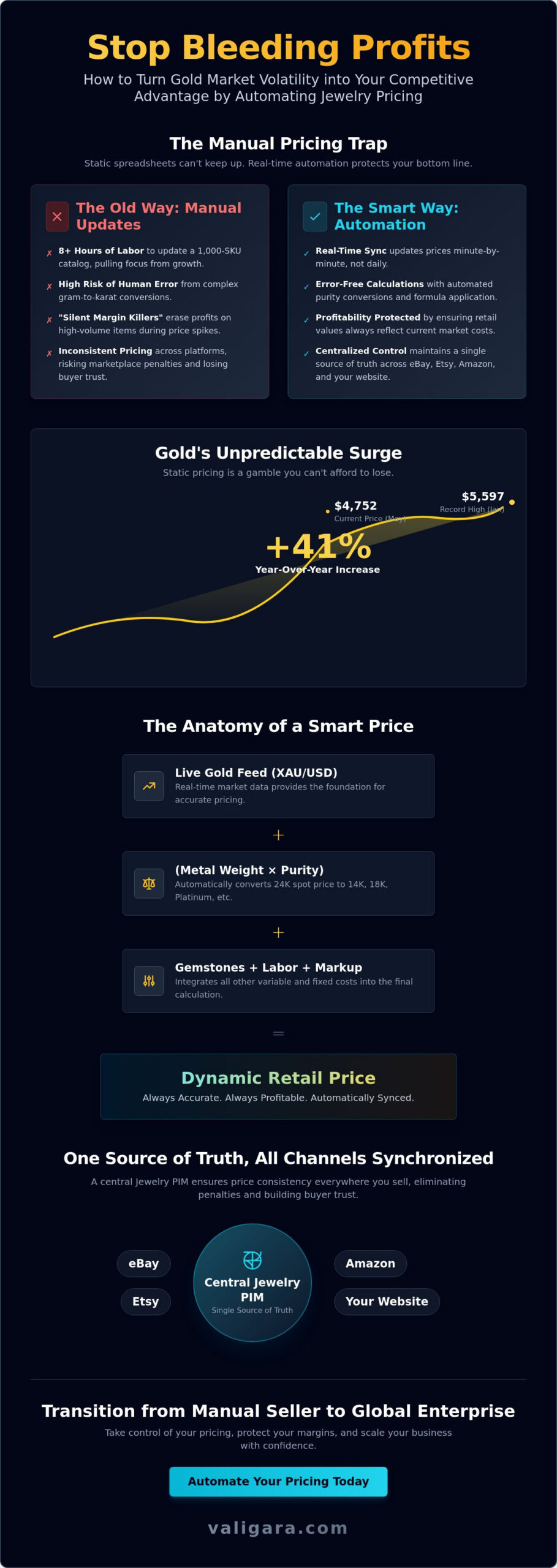
With gold prices surging over 41% year-over-year to reach $4,752 per ounce this May, your static price tags are likely eroding your profit margins before a customer even clicks buy. You’ve felt the frustration of watching market volatility turn a high-value sale into a break-even headache because your spreadsheets couldn’t keep up. Manually updating metal costs across eBay, Etsy, and your own website isn’t just tedious; it’s a liability that leaves your business vulnerable to rapid market shifts. When gold reached its record high of $5,597 in January, many jewelers lost thousands simply because they couldn’t sync their inventory fast enough.
It’s time to transition from a struggling manual seller to a streamlined, global enterprise. This article teaches you how to automate jewelry pricing with gold feed technology to eliminate human error and safeguard your bottom line. You’ll learn how to integrate real-time precious metal data directly into your jewelry PIM, ensuring that every carat and hallmark is priced with surgical precision. We’ll examine the strategic move to centralized control, allowing you to sync live pricing across all marketplaces while accounting for specific platform fees and labor costs. This guide provides the technical roadmap to turn market volatility into your greatest competitive advantage.
Key Takeaways
- Stop the “silent margin killer” by replacing manual spreadsheet updates with real-time market synchronization to protect profitability during price spikes.
- Master the jewelry-specific pricing formula that integrates metal weight, purity, gemstones, and labor costs into a dynamic, automated calculation.
- Learn how to automate jewelry pricing with gold feed technology to maintain a single source of truth across eBay, Etsy, and Amazon simultaneously.
- Follow a structured implementation strategy to audit your inventory data and connect live XAU/USD feeds to your central management platform.
- Scale your global operations by leveraging a specialized jewelry PIM that manages the intricate data requirements of high-value collections.
The Volatility Challenge: Why Manual Jewelry Pricing Fails in 2026
Automated jewelry pricing is the real-time synchronization of precious metal market rates with your product retail prices. In a year where gold has seen a staggering 41.58% appreciation, static pricing is no longer a viable strategy for professional jewelry brands. Relying on manual updates in 2026 is like trying to catch a high-speed train on foot. If your prices don’t move with the market, your business remains stagnant while your costs soar. To remain competitive, you must automate jewelry pricing with gold feed technology to ensure your retail values reflect the current spot price of $4,752.39 per ounce.
Industry experts often refer to the “Silent Margin Killer” as the primary threat to jewelry profitability. A seemingly minor $20 per ounce shift in the gold market can completely erase the profit on high-volume items or lightweight 14k gold collections. The Volatility Challenge is compounded when you consider that gold reached a historic peak of $5,597.23 in January 2026. Without an automated system, a jeweler selling a collection of wedding bands at “stale” prices could lose thousands of dollars in a single afternoon. Professionalism in luxury retail now demands that your pricing engine is as sophisticated as the jewelry you create.
The Human Cost of Manual Updates
Managing a 1,000-SKU catalog manually is a logistical nightmare that drains your most valuable resource: time. If an employee spends just 30 seconds updating a single listing, a full catalog refresh takes over eight hours of focused labor. This process is ripe for human error, especially during complex gram-to-karat conversions or purity adjustments. The psychological stress of constantly “watching the ticker” prevents you from focusing on design and growth. When you automate jewelry pricing with gold feed integrations, you reclaim those hours and eliminate the risk of a misplaced decimal destroying your margins.
Marketplace Penalties for Inconsistent Pricing
Competitive marketplaces like Amazon, eBay, and Etsy have strict algorithms that monitor price consistency. Discrepancies between your website and your marketplace listings can trigger account flags or the immediate loss of the “Buy Box.” Buyers in 2026 are savvy; they compare prices across platforms in seconds. If your Etsy shop shows an out-of-date price while your website has been updated, you lose buyer trust and conversion rates. Real-time synchronization is a prerequisite for scaling to global marketplaces, ensuring your brand projects reliability and authority across every digital touchpoint.
The Mechanics of Automated Pricing: Beyond the Live Gold Feed
To automate jewelry pricing with gold feed technology effectively, you must look beyond the simple spot price. A professional pricing engine doesn’t just track the market; it deconstructs every piece into its fundamental components. The “Jewelry Price Formula” is a multi-variable equation: (Metal Weight x Purity) + Gemstone Costs + Labor + Markup. While generic tools often stop at the metal weight, a jewelry-specific system integrates these variables directly into your Jewelry PIM, ensuring that every time the market shifts, your entire catalog recalculates with surgical precision.
The efficiency of this system relies heavily on the frequency of synchronization. In a volatile market, daily updates are often insufficient to protect your margins. Professional systems utilize a live gold feed to perform minute-by-minute adjustments. This ensures that a sudden spike in XAU/USD prices is reflected in your retail price before a customer completes their checkout. By establishing “Global vs. Category” pricing rules, you can apply broad shifts to your entire inventory or set specific parameters for high-end diamond collections where the metal-to-gemstone ratio differs significantly.
Calculating Metal Value by Purity
Precision in metal calculation is the foundation of margin protection. Your system must automatically convert the 24K spot price into the specific values for 14K, 18K, or Platinum 950. Karatage conversion is the automated division of spot price by 24 multiplied by the target purity. Beyond the base purity, the engine accounts for specific alloy surcharges, such as the premium costs associated with high-quality palladium used in white gold or the specific density of rose gold alloys. This level of granular control ensures that your Jewelry PIM remains the definitive source of truth for your business.
Integrating Labor and Gemstone Constants
While the metal component of a ring is dynamic, other costs remain fixed. A sophisticated pricing engine allows you to lock in labor costs per SKU or collection while the metal value fluctuates. Gemstone price lists are managed as separate but integrated variables; a 1.00-carat GIA-certified diamond maintains its value even as the gold setting’s price changes. Dynamic markups add a final layer of strategic control, allowing you to set higher percentage markups for lower-priced sterling silver items while maintaining competitive margins on high-ticket 18K gold and gemstone pieces.
Multi-Channel Synchronization: Keeping eBay, Etsy, and Amazon in Sync
Scaling a jewelry brand across global marketplaces requires more than just a listing tool; it demands a central brain that acts as your single source of truth. When you automate jewelry pricing with gold feed technology, you ensure that every sales channel reflects the same underlying metal value simultaneously. Valigara functions as this central engine, pushing price updates to multiple APIs without manual intervention. This eliminates the risk of a customer purchasing an 18K gold ring on eBay at yesterday’s price while your website has already adjusted for a market spike. Centralized control is the only way to maintain brand integrity and profit margins across a fragmented digital landscape.
Managing marketplace-specific markups is a critical component of this synchronization. Each platform has a distinct fee structure that can quickly erode your profits if ignored. For instance, eBay charges a 15% fee for jewelry items under $5,000, while Amazon’s referral fees can reach 20% for items under $100. By applying sophisticated Automated Pricing Formulas, you can automatically adjust your retail prices per channel to account for these variables. This ensures your net profit remains consistent whether a sale happens on your Vite-powered storefront or a high-traffic marketplace. Real-time stock synchronization must work in tandem with price updates to prevent the nightmare scenario of overselling a high-value item that is no longer in inventory.
Overcoming Marketplace API Latency
Professional jewelry software is designed to navigate the technical hurdles of marketplace API rate limits. When gold prices shift, sending thousands of updates at once can trigger “throttling,” where a platform like Etsy or Amazon temporarily blocks your requests. Valigara manages this queue intelligently, ensuring that your most critical price changes are processed within seconds. Detailed update logs provide full transparency, allowing you to track exactly when and why a price changed on any specific channel. This level of technical precision is what separates a professional operation from a struggling manual seller.
Currency Conversion and Global Selling
Expanding into international markets requires your pricing engine to handle complex currency conversions in real-time. Your system must automatically translate gold prices from USD to EUR, GBP, or AUD based on the latest exchange rates while also factoring in regional taxes like VAT. Multi-currency support prevents exchange rate losses by ensuring your international listings are always pegged to the current metal spot price and local currency values. This automation allows you to dominate global markets without the constant stress of manually recalculating prices for every region you serve.
Implementation Strategy: Setting Up Your Automated Pricing Formulas
Transforming your jewelry business into a streamlined enterprise requires a meticulous implementation strategy. Precision is non-negotiable when your inventory value fluctuates with the global market. To effectively automate jewelry pricing with gold feed technology, you must start with a clean data foundation. This process moves beyond simple software installation; it’s about building a robust logic that protects your brand and your bottom line. Follow these five essential steps to deploy your automated pricing engine:
- Step 1: Audit Inventory Data. Verify that every SKU has accurate metal weights and purity tags. An error in the gram weight of an 18K gold ring will lead to compounding pricing mistakes once the feed goes live.
- Step 2: Connect the Live Feed. Integrate your central management platform with a reliable XAU/USD data source to ensure your system reflects the current $4,752.39 gold spot price.
- Step 3: Define the Base Formula. Build your primary calculation including labor, gemstones, and target markups. Test this formula on a small subset of 10 to 20 items before a full rollout.
- Step 4: Establish Safety Buffers. Set rules to handle market volatility and rounding preferences. This step prevents “nervous pricing” where retail values shift too frequently for minor market jitters.
- Step 5: Execute Global Sync. Push the updates across all channels and monitor marketplace performance to ensure APIs are reflecting the new values correctly.
Execution is only as good as the tools you use. To see these steps in action, explore how a specialized jewelry management platform can simplify your transition to full automation.
Defining Safety Buffers and Thresholds
Safety buffers are your primary defense against extreme volatility. By establishing a “Minimum Change” threshold, such as $5.00, you avoid the unprofessional look of retail prices that shift by pennies every few minutes. You should also implement price ceilings and floors to protect your catalog from feed anomalies or rare flash crashes. Strategic rounding rules are equally vital; always rounding to the nearest .99 or .00 maintains the psychological pricing standards your customers expect in the luxury trade.
Testing and Quality Assurance
Never push pricing updates live without a thorough testing phase. Use a sandbox or preview mode to visualize how your new formulas affect different product tiers. Spot-check high-value items, such as 2ct diamond rings, against lightweight gold bands to ensure the logic holds across varying price points. Setting up automated alerts is the final safeguard; your system should notify you immediately if gold prices cross a critical threshold, like the record $5,597.23 seen earlier this year, allowing for a manual review if necessary.
Scaling with Valigara: The Central Engine for Jewelry Pricing
Valigara stands as the only platform engineered specifically to handle the intricate data structures of the jewelry and gemstone trade. While generic e-commerce tools struggle with the nuances of carats or hallmarking, our system was forged in the high-stakes environment of the Israeli Diamond Exchange. This expert insider perspective ensures that when you automate jewelry pricing with gold feed technology, the software understands the difference between a gold-plated item and a solid 18K gold ring. By integrating the Jewelry PIM directly with real-time market data, Valigara becomes the central engine that drives your entire global operation with surgical precision.
This integration effectively solves the “Growth Paradox.” In the manual era, expanding your catalog from 100 to 1,000 SKUs required a proportional increase in administrative staff to manage pricing updates and inventory sync. With Valigara, you can list 10x more products across unlimited channels without adding a single person to your payroll. The system handles the heavy lifting of multi-channel synchronization, allowing your team to focus on craftsmanship and customer relationships rather than spreadsheets. It’s the essential transition from a struggling manual seller to a streamlined, high-tech enterprise ready to dominate the 2026 market.
Beyond Gold: Automating Silver, Platinum, and Palladium
Professional collections often span the full spectrum of precious metals. Valigara supports dynamic feeds for silver, platinum, and palladium, ensuring your entire inventory is protected from market shifts. The system excels at managing complex, multi-metal items. For example, a gold ring featuring platinum prongs is managed as a single SKU with two distinct dynamic metal components. This level of technical precision future-proofs your business, ensuring you never lose money on a sale because a secondary metal price spiked unexpectedly. You maintain centralized control over every alloy in your collection through a single interface.
Getting Started with Your Personal Onboarding
Precision requires professional setup. Valigara includes a one-time onboarding process to ensure your automated pricing formulas are perfectly aligned with your specific workshop or retail workflow. Our experts help you configure your safety buffers, marketplace markups, and rounding rules from day one. This proactive approach eliminates the learning curve and guarantees that your system is a reliable source of truth for your business. Don’t let market volatility dictate your profit margins. Schedule your walkthrough to automate your jewelry pricing and take full control of your business scalability today.
Secure Your Jewelry Business for 2026 and Beyond
The era of manual pricing in the jewelry trade is over. As gold prices reach historic highs, your profitability depends on your ability to react to market shifts in real-time. You’ve established that market volatility is a permanent challenge; manual updates are a liability that erodes buyer trust and erases profit margins. By centralizing operations through a specialized Jewelry PIM, you ensure every sales channel reflects your exact pricing logic without delay. It’s time to automate jewelry pricing with gold feed technology to reclaim your time and focus on the artistry of your collections.
Valigara is trusted by top online jewelry sellers to manage high-value inventory with surgical precision. Our expert onboarding for complex inventory ensures your formulas are perfectly calibrated from day one, providing a seamless integration between your workshop and the global market. Don’t let market fluctuations dictate your success. Transition from a struggling manual seller to a streamlined, global enterprise with the industry’s most sophisticated pricing engine.
Automate your jewelry pricing and protect your margins with Valigara
Your business deserves the precision of high-tech automation paired with the respect of traditional craftsmanship. We’re ready to help you scale.
Frequently Asked Questions
Does the gold feed update prices on eBay and Etsy automatically?
Yes, Valigara uses direct API integrations to push price changes to eBay, Etsy, and Amazon simultaneously. When the market shifts, the software recalculates your retail price based on your specific formula and updates every listing without manual intervention. This ensures that your multi-channel sales are always synchronized with the current spot price, protecting your margins across all platforms regardless of market volatility.
Can I set different markups for different jewelry collections?
You can absolutely define unique markups for specific collections or categories within the system. For instance, you might apply a higher percentage markup to sterling silver jewelry while maintaining a lower, more competitive margin on high-ticket 18K gold and gemstone pieces. This granular control allows you to align your pricing strategy with the specific market demand and production costs of each unique collection in your inventory.
What happens if the gold price drops significantly?
If gold prices drop, your retail prices will decrease automatically to maintain competitiveness, unless you’ve established a “Price Floor.” These safety buffers prevent your prices from falling below a specific threshold, ensuring you don’t sell below your original manufacturing cost. You maintain full control over how the system responds to downward volatility to safeguard your business stability and maintain consistent profitability.
Do I need to enter the metal weight for every single SKU?
Accurate metal weights are required for every SKU to ensure the pricing engine functions with surgical precision. While this requires an initial data audit, Valigara’s Jewelry PIM allows for bulk uploads and mass editing to streamline the process. Entering precise weights once enables the system to automate jewelry pricing with gold feed data indefinitely, eliminating the need for any future manual calculations or spreadsheet updates.
Is it possible to automate pricing for silver and platinum as well?
Yes, the system supports automated pricing for the full spectrum of precious metals including silver, platinum, and palladium. You can connect multiple feeds to manage a diverse inventory across various material types. The engine even handles multi-metal items, such as a gold ring with platinum prongs, by calculating each component’s value separately before combining them into a single, dynamic retail price for your storefront.
How does automated pricing affect my SEO on marketplaces?
Automated pricing can positively impact your marketplace SEO by signaling to algorithms that your listings are active and accurately maintained. It’s important to use “Minimum Change” thresholds to avoid excessive updates that could trigger marketplace throttling. Consistent, market-accurate pricing builds buyer trust, which directly improves your conversion rates and overall search rankings on competitive platforms like Amazon and eBay.
Can I manually override the automated price for specific items?
You can manually override the automated price for any specific item at any time. While the gold feed provides the baseline for your dynamic pricing, certain one-of-a-kind pieces or promotional items may require a fixed retail value. The system allows you to lock these prices, ensuring they remain static even when the broader market experiences significant fluctuations or record-breaking price peaks.
Does Valigara support gemstone pricing feeds alongside gold?
Valigara integrates gemstone and diamond price lists directly into your automated formulas. While gold prices are dynamic via live feeds, you can manage gemstone values as constants or separate variables within the Jewelry PIM. This comprehensive approach ensures that the total value of your jewelry reflects both the current metal market and the specific carats and quality of your diamonds and gemstones.