
A generic e-commerce platform is a storefront, not a diamond vault. Treating them as the same is exactly why most scaling jewelry brands hit an operational ceiling long before they reach their full potential. If you’re still relying on manual spreadsheets to track gold market fluctuations or gemstone certificates, you aren’t just wasting time; you’re risking your reputation. Effective shopify jewelry inventory management requires more than basic stock counts. It demands a specialized system that understands the granular complexity of carats, cuts, and metal weights across a global multi-channel landscape.
You likely already feel the friction of overselling on Etsy while your Shopify stock looks healthy, or the dread of manual data entry for every new variation. It’s a common bottleneck, but it’s one you can solve. This guide shows you how to move your brand from manual chaos to automated precision by centralizing your product data and synchronizing every sales channel in real time. We will explore the transition from manual entry to a high-performance PIM that handles the technical precision your luxury brand demands while eliminating the risk of human error.
Key Takeaways
- Identify why generic e-commerce tools fail to track the granular specifications required for high-value jewelry items and luxury scaling.
- Master the technicalities of gemstone grading and precious metal valuation to ensure your digital catalog reflects real-time market shifts.
- Synchronize your inventory across global marketplaces to eliminate overselling and centralize all orders within a single, authoritative hub.
- Implement a professional shopify jewelry inventory management workflow that replaces manual data entry with automated attribute mapping and PIM integration.
- Transition from a simple storefront to a global enterprise by leveraging a specialized jewelry ERP as your core operational intelligence.
Why Shopify Native Inventory Fails for Scaling Jewelry Brands
Jewelry inventory management is far more than a simple count of units in a warehouse. It exists at the precise intersection of high-value asset tracking and complex, multi-dimensional data. While Shopify excels as a front-end sales engine, its native architecture was built for “one-size-fits-all” retail. For a scaling jewelry brand, relying solely on these basic tools creates a glass ceiling that stifles growth and invites significant financial risk.
Many founders begin their journey with manual spreadsheets. This “spreadsheet creep” is a silent killer of efficiency. It works when you have fifty pieces, but the system inevitably fractures once you cross the 500 SKU threshold. At this scale, manual data entry becomes a full-time liability. A single typo in a gold weight or a misplaced decimal in a gemstone carat count doesn’t just mess up a report; it directly erodes your bottom line. Transitioning to a professional inventory management software is the only way to maintain the surgical precision required for luxury retail.
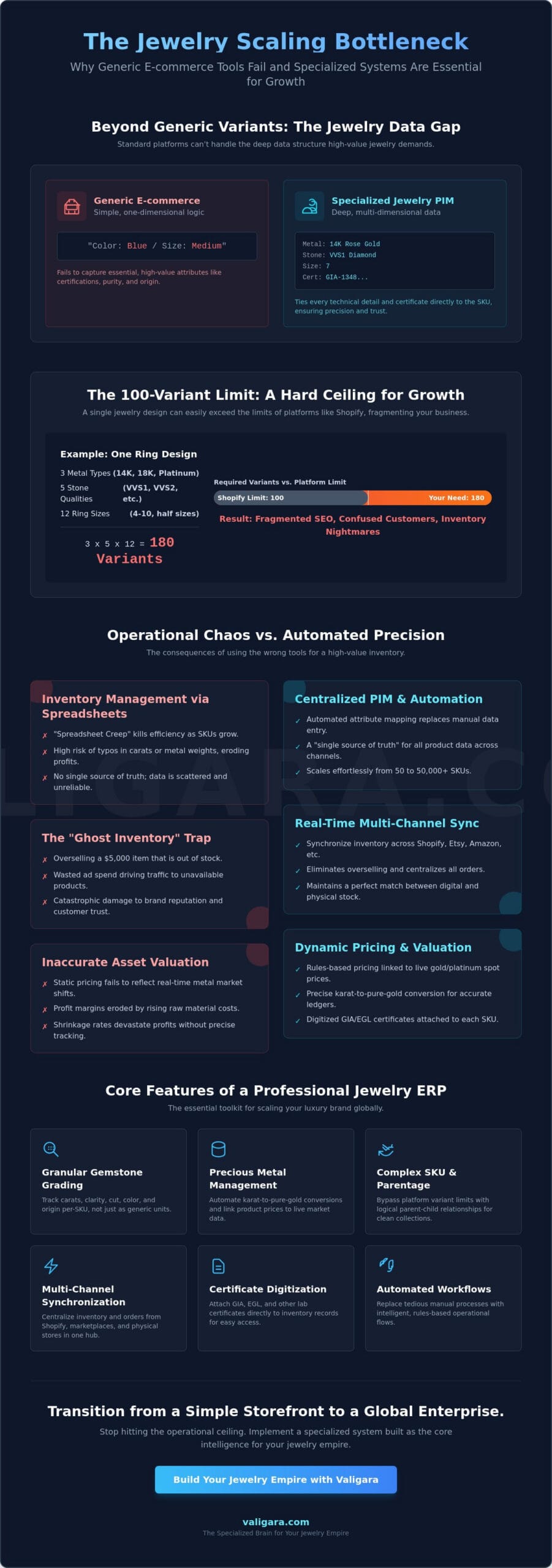
Shopify’s most significant bottleneck is its 100-variant limit. While 100 options might seem plenty for a t-shirt brand, jewelry complexity scales exponentially. Consider a single ring design offered in three metals (14K, 18K, Platinum), five different center stone qualities, and twelve ring sizes. You have already reached 180 variants for one single product. Shopify forces you to split these into separate listings, which fragments your SEO, confuses your customers, and makes shopify jewelry inventory management a fragmented nightmare.
This fragmentation leads to the “Ghost Inventory” trap. In high-ticket luxury retail, selling a $5,000 item that is actually out of stock is a catastrophic failure. It results in immediate capital tied up in refunds, wasted ad spend, and a permanent stain on your brand reputation. You aren’t just losing a sale; you’re losing the lifetime value of a client who no longer trusts your digital storefront.
The High-Value, Small-Size Dilemma
Jewelry presents a unique challenge: items are incredibly small but carry immense value. This makes frequent audits and high-resolution tracking mandatory. In 2026, even a 2% shrinkage rate can devastate profit margins as raw material costs continue to climb. In the context of precious metals, inventory accuracy is the absolute verification that every gram of physical stock matches your digital ledger across every karat and alloy type you carry.
Beyond Generic Variants: The Jewelry Data Gap
The logic used by generic platforms to categorize “Blue/Medium” items fails when applied to “14K Rose Gold/VVS1 Diamond/Size 7.” Jewelry requires a deep data structure that includes stone origin, lab certifications, and metal purity. Without a Jewelry PIM, this vital information lives in disparate PDF files or sticky notes. You need a single source of truth that ties every gemstone certificate directly to the SKU, ensuring that the technical precision of your craft is reflected in your digital operations.
Core Features of Professional Jewelry Inventory Systems
Scaling a luxury brand requires a fundamental shift from simply tracking products to managing complex assets. Professional systems differ from generic apps by treating every component of a jewelry piece as a unique, searchable data point. Effective shopify jewelry inventory management relies on granular gemstone grading. You must track carats, clarity, and cut per SKU rather than just total units. This level of detail allows for precise valuation and helps in implementing effective inventory management strategies that prioritize high-margin assets over stagnant stock.
Beyond stones, precious metal management is a critical requirement. A professional system handles karat-to-pure-gold conversion automatically, ensuring your internal ledger is always accurate. It also facilitates certificate digitization. By attaching GIA or EGL files directly to inventory records, you ensure that the provenance of every stone is just a click away. This eliminates the need to search through physical files when a customer asks for verification on your Shopify site. Dynamic pricing models then take this data and allow you to set rules based on the current spot price of gold or platinum. This means your 18K bridal collection always reflects its true value, even if you haven’t touched the backend in weeks.
Managing Complex SKUs and Variations
Structuring jewelry collections requires a logical hierarchy. You must establish parent-child relationships that account for every metal, stone, and size combination. Automating SKU generation for yellow, white, and rose gold variants prevents the naming inconsistencies that plague manual systems. Mastering shopify jewelry inventory management through automation allows you to focus on design rather than data entry. In 2026, the best systems also distinguish between individual high-value stones and parcel stock. This allows you to track unique serial numbers for large diamonds while managing melee by weight, providing a comprehensive view of your entire material pool.
Real-Time Gold Feed Synchronization
Manual price updates are a recipe for lost revenue. If the gold market spikes while your Shopify prices remain static, your margins vanish. Integrating live market data ensures your storefront remains profitable without constant human intervention. Using a specialized tool like Valigara automates this process by pulling live feeds directly into your pricing logic. Real-time gold feed synchronization protects your margins during market volatility by adjusting retail prices the moment raw material costs fluctuate. This level of automation transforms your inventory from a static list into a live, responsive financial asset that reacts to global economic shifts instantly.
Synchronizing Shopify with Global Marketplaces
Scaling your jewelry brand globally means moving beyond the boundaries of a single storefront. While Shopify acts as a powerful face for your brand, your presence on eBay, Amazon, and Etsy is what drives high-volume growth. However, managing these channels in isolation is a high-stakes gamble. Selling a one-of-a-kind sapphire ring on Etsy seconds after it sold on Shopify isn’t just an inconvenience; it’s a breach of trust that can lead to marketplace penalties and a tarnished reputation. To prevent this, you must standardize your inventory management processes to ensure total synchronization across every touchpoint.
Centralizing your operations allows you to handle marketplace-specific nuances without doubling your workload. Etsy, for example, requires specific jewelry attributes like “handmade” or “vintage” classifications that differ from Amazon’s rigid catalog requirements. A specialized system translates your core product data into these specific formats automatically. This centralized control also extends to global inventory distribution. Whether your stock is sitting in a retail safe in New York or a secure warehouse in Hong Kong, your shopify jewelry inventory management system must provide a unified view of your global assets in real time.
The Multi-Channel Jewelry Sales Hub
To scale effectively, your architecture must follow a “Master and Slave” logic. Your specialized inventory software acts as the “Master”—the single source of truth—while Shopify and other marketplaces act as “Slaves” that receive updates. This setup is the foundation of Multi-channel Listing Automation. It allows you to push updates to five or more channels simultaneously, ensuring that a price change or a stock adjustment is reflected everywhere in seconds. You no longer manage stores; you manage a global enterprise from a single hub.
Preventing the “Out of Stock” Nightmare
Buffer stock levels are your primary defense against the volatility of high-demand jewelry. By setting a buffer of “one” for your most popular gold mountings, you ensure that your shopify jewelry inventory management system marks an item as out of stock on marketplaces before your physical count actually hits zero. This small margin of safety protects your seller ratings. Additionally, for brands using pre-order models, “Virtual Stock” allows you to sell based on component availability rather than finished pieces. If you have the stones and the settings ready, the system knows you can fulfill the order, even if the final ring hasn’t been assembled yet.
Implementing Your Jewelry Inventory Workflow
Transitioning from a manual operation to an automated enterprise is a strategic migration, not a simple software installation. To achieve true shopify jewelry inventory management, you must first cleanse your data. This means moving away from fragmented, multi-tab spreadsheets and into a structured Jewelry PIM. You can’t scale on messy data. Every diamond clarity, metal karat, and setting style needs a standardized home before you attempt to sync with a live storefront.
Once your data is clean, the next step is attribute mapping. You must identify every technical detail of your pieces—from the specific gram weight of 14K gold to the GIA certificate number of a center stone. With these attributes mapped, you establish the sync. This connection turns Shopify into a high-performance outlet for your central inventory hub. Beyond stock counts, this workflow enables sophisticated marketing automation. You can use real-time inventory levels to trigger “limited edition” social media campaigns or “back in stock” emails the moment a gemstone is replenished.
Barcode and Tag Printing for Precision
The bridge between your physical safe and your digital store is the barcode. In 2026, tagging small, high-value items requires specialized jewelry labels that don’t leave adhesive residue or damage delicate filigree. Integrating barcode scans directly with your Shopify order fulfillment ensures that the exact piece picked is the exact piece shipped. For high-volume brands, RFID technology now allows for 30-second stock takes, scanning entire trays of rings without ever removing them from their displays. This level of precision eliminates the human error that typically leads to inventory discrepancies.
Automating Fulfillment and Logistics
Scaling also means expanding your sales models. A professional workflow allows you to generate pro-grade jewelry PDF catalogs for B2B clients directly from your live inventory data. This ensures your wholesale partners always see accurate stock levels and pricing. When an order is placed, automated order routing can reduce manual labor by 70% by instantly selecting the best fulfillment path and streamlining the shipping of insured, high-value packages. By removing the manual burden of logistics, you free your team to focus on brand growth and client relationships. To see how these workflows can transform your operations, explore Valigara’s jewelry management platform for a complete end-to-end solution.
Valigara: The Specialized Brain for Your Jewelry Empire
Valigara isn’t a simple plugin; it’s a specialized jewelry ERP designed to handle the structural complexities of luxury retail. While generic apps struggle with basic variants, Valigara provides a robust foundation for shopify jewelry inventory management by integrating deep industry logic into every workflow. It acts as the central intelligence of your business, ensuring that your data remains accurate across every channel you occupy. You don’t just manage stock; you manage a sophisticated digital ecosystem with total confidence.
The system includes built-in Diamond and Gemstone management, a feature set that general-purpose e-commerce tools simply lack. You can manage parcels, individual certified stones, and mounting stock within the same environment. This eliminates the need for third-party databases or disconnected spreadsheets. Additionally, the Vite eCommerce engine offers a high-performance alternative for brands that need lightning-fast load times and specialized jewelry layouts that convert high-ticket browsers into buyers.
Scalability is where Valigara truly excels. Whether you’re managing 100 hand-crafted pieces or a catalog of 10,000+ SKUs, the system maintains the same level of ease and precision. It removes the operational friction that typically slows down large-scale enterprises, allowing you to focus on strategic expansion rather than data maintenance. As your SKU count grows, the software’s logic scales with you, ensuring your shopify jewelry inventory management remains as tight at 10,000 items as it was at 100.
Empowering Jewelry Brands to Scale Globally
Transitioning to an automated hub provides immediate, measurable results. Some manufacturers report saving over 40 hours a month on listing automation alone by eliminating repetitive manual tasks across multiple marketplaces. This is the Expert Insider advantage: software built by professionals who understand the specific pain points of the jewelry trade. Schedule a demo to see how Valigara transforms your Shopify operations and take control of your global digital presence.
2026 Tech: AI and Analytics for Jewelry
Future-proofing your brand requires more than just reactive stock tracking. Valigara Insights uses advanced analytics to help you predict which designs will trend next season based on real-time sales data and marketplace movement. This intelligence allows for smarter purchasing decisions and optimized inventory levels, reducing the capital tied up in slow-moving stock.
Marketing automation within the platform speaks the specific language of luxury retail. It doesn’t just send generic blasts; it uses your granular inventory data to create targeted campaigns that resonate with high-value clients. By centralizing your operations, you insulate your brand against marketplace algorithm changes and ensure your business remains agile in an ever-evolving digital landscape. You’re no longer at the mercy of platform updates; you’re the master of your own data-driven destiny.
Master the Future of Digital Jewelry Retail
Scaling a luxury brand requires a departure from the manual limitations of the past. You now understand why generic platforms fail to capture the technical nuances of gemstone grading and live gold market shifts. Transitioning to a professional shopify jewelry inventory management system is a strategic necessity for global expansion. By centralizing your product data and automating your multi-channel synchronization, you protect your brand’s reputation and your profit margins simultaneously.
Valigara is trusted by 500+ jewelry brands worldwide to act as the core intelligence of their digital operations. Our specialized PIM for diamonds and gemstones allows you to manage high-value assets with surgical precision across every sales channel. Most users reduce their manual workload by up to 80%, freeing up hundreds of hours to focus on design and client acquisition. Automate Your Jewelry Inventory Today and bridge the gap between traditional craftsmanship and high-tech automation. Your global enterprise is ready to scale.
Frequently Asked Questions
Can Shopify handle gemstone-specific data natively?
Shopify doesn’t natively support granular gemstone attributes like clarity, cut, or carat weight. While you can use meta-fields, this approach lacks the structural integrity needed for professional diamond and gemstone management. A specialized system is required to handle these technical specifications and ensure they remain synchronized across all your sales channels. This allows you to maintain a surgical level of detail that generic e-commerce platforms simply weren’t designed to provide.
How do I sync my jewelry inventory between Shopify and Etsy?
You must use a centralized inventory hub to synchronize stock levels across Shopify and Etsy effectively. When an item sells on one platform, the software instantly updates the quantities on the other. This real-time automation is critical for shopify jewelry inventory management, as it prevents the reputational damage caused by overselling. Manual updates are too slow for scaling brands and often lead to costly fulfillment errors.
What is the best way to manage gold price fluctuations on Shopify?
Integrating an automated gold feed sync is the most efficient way to handle market volatility. This technology pulls live market data and adjusts your retail prices based on the specific metal weight of each piece. It eliminates the need for manual labor and protects your profit margins during sudden spikes in precious metal prices. Without this automation, you risk selling high-value items at prices that don’t reflect their raw material cost.
Do I need a separate PIM for my jewelry business?
A dedicated Jewelry PIM is essential for any brand scaling beyond the initial startup phase. Generic platforms struggle with the complex data structures inherent in jewelry, such as stone-to-metal mapping and certificate tracking. A PIM serves as your central intelligence, organizing your technical data before it ever reaches your Shopify storefront. It ensures that your global product information remains consistent, accurate, and ready for multi-channel distribution.
How can I prevent overselling high-value one-of-a-kind pieces?
Real-time synchronization combined with buffer stock settings is the only reliable way to prevent overselling unique items. The moment a transaction begins on one channel, your management software must lock that inventory across all other platforms. This is especially vital for one-of-a-kind pieces where a replacement is impossible. Automated stock locking preserves your brand’s reliability and prevents the administrative nightmare of processing refunds for high-ticket items.
Is barcode scanning necessary for a small jewelry business on Shopify?
Barcode scanning is a critical accuracy tool even for smaller operations looking to scale. It creates a physical-to-digital link that ensures you pick, pack, and ship the exact item ordered. As your SKU count increases, manual identification becomes a liability. Implementing barcode and tag printing early in your growth cycle establishes a professional workflow that reduces shrinkage and streamlines your annual inventory audits.
Can I manage diamond certifications (GIA) within my inventory software?
Specialized jewelry software allows you to link GIA or EGL certifications directly to individual gemstone records. This digitization ensures that vital provenance data is never lost in a physical filing system. You can instantly provide these certificates to customers or B2B partners, building immediate trust. It transforms your inventory from a simple list into a comprehensive digital vault of your brand’s most valuable assets.
How does multi-channel automation affect my Shopify SEO?
Multi-channel automation strengthens your shopify jewelry inventory management and SEO by maintaining data consistency and reducing out-of-stock errors. Search engines reward stores that provide accurate, technical product data and reliable availability. By pushing rich gemstone and metal attributes from a central hub, you increase the chances of ranking for specific, high-intent search queries. It ensures your digital presence is as professional as your physical craftsmanship.