
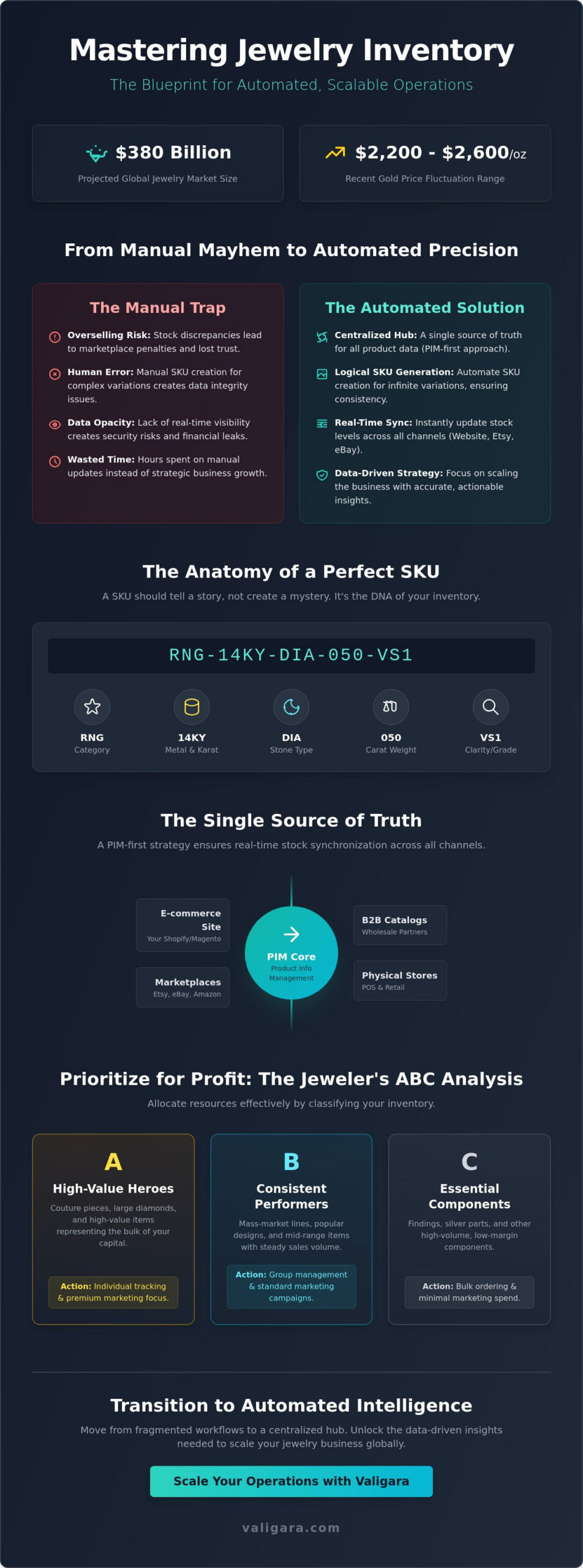
What if a single decimal point error in a gemstone weight or a missed stock update on a high-value necklace costs you a premier seller rating? In a global market projected to reach $380 billion this year, precision isn’t just a preference. It’s the baseline for survival. You likely already feel the frustration of chasing manual updates across Etsy and eBay while gold prices fluctuate between $2,200 and $2,600 per ounce. It’s a high-stakes balancing act that often leaves little room for actual business strategy or creative growth.
Mastering jewelry inventory control best practices is the only way to transition from reactive manual labor to proactive, scalable operations. This guide provides the blueprint to eliminate overselling and automate the complexities of gemstone and metal data management across every sales channel. We will detail how to implement real-time stock synchronization, leverage automated SKU generation for complex variations, and establish a centralized hub that serves as the core intelligence of your global enterprise.
Key Takeaways
- Learn why jewelry inventory demands a specialized approach that accounts for fluctuating metal prices and high-value data complexity.
- Discover how to implement jewelry inventory control best practices through a logical SKU structure designed for gemstone and metal variations.
- Eliminate the risk of marketplace penalties by replacing manual spreadsheets with automated, real-time stock synchronization across all sales channels.
- Optimize your physical operations by balancing tag aesthetics with high-speed scannability using modern barcoding and RFID technologies.
- Transition from fragmented manual workflows to a centralized operational hub that provides the automated intelligence needed to scale globally.
The High-Stakes Reality of Jewelry Inventory Control in 2026
Standard retail logistics usually focus on moving high volumes of low-value units. In the jewelry trade, you’re managing value density. A single misplaced tray or an unrecorded sale can represent a quarter’s worth of profit. 2026 has introduced even more volatility into this equation. Gold prices have fluctuated between $2,200 and $2,600 per ounce this year, meaning your stock valuation changes almost daily. If your internal systems don’t reflect these fluctuations in real-time, your reported margins are effectively imaginary.
Deadstock is another silent profit killer in the luxury environment. While a traditional retailer might simply discount old apparel, a jeweler has thousands of dollars tied up in precious materials that aren’t moving. That’s capital that isn’t purchasing new stones or funding your next marketing campaign. For entrepreneurs looking to unlock liquidity from other assets to reinvest in their stock, V8Loans offers specialized secured lending options. Adopting jewelry inventory control best practices means shifting from a “count it once a year” mindset to a “manage the data every second” strategy. This digital integrity is what separates a struggling boutique from a scalable global enterprise.
High-Value Assets and Security Risks
Physical safes and biometric locks are standard, but the modern threat to your bottom line is data opacity. If you don’t know exactly where a piece is at any given moment, you can’t protect it. Implementing a robust inventory control system allows for regular cycle counts without shutting down your entire operation. These micro-audits help identify internal shrinkage or fulfillment errors before they become systemic issues. Real-time visibility isn’t just a convenience for your sales team; it’s your primary defense against financial leaks.
The Complexity of Jewelry SKU Architecture
Managing a single design is rarely a linear process. One ring mounting might be available in 14k yellow gold, 18k white gold, or platinum, each paired with various diamond clarities or center stone weights. These variations multiply your management workload exponentially. If you’re manually creating SKUs for every possible combination, you’re inviting human error and creating a bottleneck that prevents rapid growth.
A PIM-first (Product Information Management) approach is the only way to maintain jewelry inventory control best practices at scale. By centralizing the technical specifications of your metals, gemstones, and findings, you create a single source of truth. This ensures that when a customer buys a specific VVS1 diamond ring on your website, the stock levels for that mounting and stone update across Etsy, eBay, and your B2B catalogs instantly. It’s about building a digital architecture that can handle the technical weight of your luxury assets.
Architecting Your Inventory: SKU Structure and Categorization
Effective jewelry inventory control best practices start with a logical architecture. You can’t manage what you can’t identify. A SKU should be a shorthand story of the item. For example, “RNG-14KY-DIA-050-VS” immediately identifies a ring in 14k yellow gold with a 0.50ct VS diamond. This level of granularity is essential when managing thousands of variations across multi-channel listings. If your naming convention is vague, your data integrity will crumble as you scale.
Many jewelers struggle because they treat loose stones and finished sets as separate entities. In a high-tech workflow, these are linked. A loose diamond is a component until it’s set; your system must track it through that transition to maintain accurate valuation. Categorizing your stock into seasonal collections and evergreen staples helps you understand which pieces require aggressive marketing and which provide steady, long-term value. Using a specialized jewelry PIM allows you to automate these relationships without manual data entry.
The ABC Analysis for Jewelers
Classifying your stock is a foundational pillar of Operational Best Practices in the luxury sector. ‘A’ items are your high-value diamonds and one-of-a-kind couture pieces. They represent the bulk of your capital and require individual tracking. ‘B’ and ‘C’ items include findings, silver components, and mass-market lines. These are high-volume but lower margin. By applying this classification, you can allocate your marketing spend more effectively. Don’t waste a premium ad budget on ‘C’ items when your ‘A’ items drive the highest ROI. This data-driven approach ensures your capital isn’t trapped in stagnant stock.
Managing Gemstone and Metal Variations
Managing variations is where manual systems fail. You need a ‘parent-child’ relationship for every design. The parent is the core design, while the children are the specific combinations of ring sizes, metal colors, and stone qualities. Your system should also automate weight calculations for different metal purities. For instance, a ring in 18k gold will weigh more than the same design in 14k gold. Accurate weight data is critical for shipping costs and insurance valuations. Variation management for complex jewelry sets is the systematic organization of a single design into multiple selectable attributes, such as metal purity and stone quality, within a unified product record. Implementing these jewelry inventory control best practices ensures that your listings remain accurate across every global marketplace you touch.
Eliminating the ‘Overselling’ Risk Across Multi-Channel Marketplaces
Many jewelers fall into the ‘Spreadsheet Trap’ during their first phase of growth. It’s a manual workflow that works for ten items but breaks at a hundred. As you scale across Etsy, eBay, and Amazon, the latency between a sale on one platform and a manual update on another creates a dangerous window for overselling. In the high-stakes world of luxury retail, an out-of-stock cancellation isn’t just a lost sale. It’s a strike against your marketplace health that can take months to repair.
Marketplace algorithms prioritize reliability. High cancellation rates lead to suppressed search visibility or outright account suspension. Adopting jewelry inventory control best practices means your stock data must be dynamic, moving at the speed of your customers. Aligning these operational workflows with SBA guidelines on business management ensures your back-office infrastructure can support your front-end global expansion. You need a single source of truth that dictates stock levels to every channel simultaneously, leaving no room for human error.
Buffer stock strategies offer an additional layer of protection during high-traffic periods like Valentine’s Day or the holiday season. By setting a ‘safety’ threshold in your management software, you can hide the final unit of a popular item from public listings. This prevents the nightmare scenario of two customers purchasing the same unique piece at the exact same second. It’s a sophisticated way to protect your brand reputation while maintaining aggressive sales targets.
Synchronizing Etsy, eBay, and Amazon
Each marketplace presents a unique technical challenge. Amazon requires specific diamond grading data; Etsy prioritizes handmade attributes; eBay demands precise item specifics. Managing ‘unique’ items—one-of-a-kind pieces—is the ultimate test of your system. If a specific sapphire ring sells on eBay, it must vanish from Etsy within seconds. Automation also streamlines the ‘re-listing’ logic. If you decide to break down a stagnant piece to use its center stone in a new setting, your jewelry inventory control best practices should include an automated trigger that retires the old listing and updates the stone’s availability in your component library.
Centralized Order Fulfillment
Orders and inventory are two sides of the same coin. They must live in a unified system to prevent data silos that lead to fulfillment delays. Centralized control allows your team to generate automated pick-lists and shipping labels from one dashboard, significantly reducing lead times. By integrating your jewelry CRM data, you can also track inventory performance by customer segment. This allows you to see which regions or demographics are moving specific collections, turning your warehouse data into a powerful engine for your marketing automation efforts.
Operational Best Practices: Barcoding, Tags, and Real-Time Data
Physical inventory management in the luxury sector requires a bridge between your digital PIM and the tangible asset. Without a robust tagging system, even the most sophisticated digital architecture remains prone to human error. In 2026, the choice between traditional barcodes and RFID technology depends largely on your volume. Passive UHF RFID tags, which currently cost between $0.05 and $0.20 depending on volume, allow for rapid, bulk scanning without line-of-sight. For high-volume retailers, this technology transforms a multi-day physical count into a task that takes minutes. If you’re operating a boutique with lower turnover, traditional barcodes remain a reliable, cost-effective standard, provided they are integrated into your central management hub.
Implementing jewelry inventory control best practices means ensuring every physical tag is a direct reflection of your digital “source of truth.” When a price is updated in your system or a metal’s hallmark is corrected, your tagging hardware should be ready to reflect that change instantly. This synchronization prevents the embarrassing discrepancy between a showroom price tag and a marketplace listing. To maintain this level of precision, you need professional barcode and tag printing tools that handle the unique dimensions and durability requirements of jewelry labeling.
Professional Tagging and Labeling
A jewelry tag must balance aesthetic elegance with technical utility. It needs to contain essential data—SKU, price, and metal hallmark—without detracting from the piece’s craftsmanship. Durability is non-negotiable; tags must withstand ultrasonic cleaning and constant handling. Using specialized thermal transfer printers ensures that your labels don’t fade or smudge over time. Scannable tags are your first line of defense against shrinkage. By requiring a scan for every movement—from the safe to the display case to the shipping station—you create an immutable audit trail that protects your high-value assets.
Automating Technical Data Management
The value of a diamond often resides in its documentation. Modern jewelry inventory control best practices involve linking digital certificates from GIA or IGI directly to specific diamond SKUs. This allows your sales team to pull up grading reports instantly and ensures that the correct certificate is always dispatched with the order. Furthermore, your system must account for the market’s pulse. With gold prices fluctuating between $2,200 and $2,600 per ounce this year, manual pricing is no longer viable. Real-time gold feed integration ensures that your retail prices automatically adjust to market fluctuations, protecting your margins without requiring manual intervention. This level of automation allows you to focus on scaling your brand while the software manages the technical volatility of the trade.
Scaling with Valigara: From Manual Tracking to Automated Intelligence
Transitioning from legacy spreadsheets to a centralized intelligence hub is the defining moment for a growing jewelry brand. While manual tracking might suffice for a local boutique, it becomes a structural liability as you enter the global market, which is projected to reach $380 billion this year. The spreadsheet trap creates data silos that lead to the overselling and inaccuracies discussed earlier. Valigara functions as the specialized brain of your operation, moving your business from reactive manual workflows to a state of streamlined, automated intelligence.
Adopting jewelry inventory control best practices requires a system that understands the technical nuances of your trade. Generic e-commerce tools fail because they don’t account for the complexity of gemstone carats, metal purities, or diamond certifications. By centralizing your operations, you ensure that your high-value multi-channel growth is built on a foundation of data integrity rather than human effort. This transition isn’t just about efficiency; it’s about empowering your brand to scale without the proportional increase in back-office overhead.
The All-in-One Advantage
The core strength of a specialized platform is the convergence of Jewelry PIM, CRM, and inventory management into a single hub. This unified architecture allows you to manage the specific attributes of diamonds and gemstones with surgical precision. When you automate your listing tools, you can reduce manual labor by up to 80%, allowing your team to focus on high-level strategy rather than SKU entry. Because the system is built for the trade, it handles complex variations and component-level tracking natively, ensuring that your stock levels remain accurate across every global marketplace you touch.
Future-Proofing Your Jewelry Brand
Scaling a brand in 2026 requires more than just current visibility; it requires predictive power. By leveraging Valigara’s insights and analytics, you can use historical data to optimize your material purchasing and anticipate market trends. If your data shows a surge in demi-fine jewelry—a segment growing at nearly 12% annually—you can adjust your inventory levels before the competition reacts. This data-driven approach turns your inventory from a static asset into a dynamic engine for growth. Expanding to new global marketplaces becomes a one-click operation, removing the technical hurdles to international expansion. Is it time to automate? Book a personal Valigara demo today.
Master the Future of Jewelry Operations
The transition from manual stock tracking to automated intelligence is the most significant leap a jewelry brand can take in 2026. By architecting a logical SKU structure and embracing real-time synchronization, you eliminate the risks of overselling and data fragmentation. Implementing these jewelry inventory control best practices ensures that your high-value assets are protected by data integrity rather than human effort. You’ve seen how centralized control over gemstones, metals, and certifications creates a scalable foundation for global growth.
Since 2009, Valigara has served as the expert partner for jewelers navigating this digital transformation. With direct GIA integration, real-time gold feed sync, and seamless multi-channel connectivity for eBay, Etsy, and Amazon, the platform acts as the core intelligence of your business. It’s time to move beyond the limitations of manual labor and reclaim your time for creative and strategic expansion. Scale your jewelry business with Valigara’s automated inventory control and lead the market with precision. Your journey toward a streamlined, global enterprise starts with a single, smart decision.
Frequently Asked Questions
What is the best way to track jewelry inventory for a small business?
The most effective way to track stock is through a specialized jewelry inventory management system rather than static spreadsheets. Small businesses often outgrow manual entry once they expand to a multi-channel presence. A centralized hub allows you to synchronize stock across every platform instantly, reducing the risk of human error. This transition ensures your high-value items are managed with the precision required for luxury retail.
How do I manage jewelry SKUs with multiple variations like metal and size?
Implementing a parent-child SKU architecture is the industry standard for managing complex variations. The parent SKU represents the core design, while child SKUs account for specific attributes like 14k yellow gold or a size 7 ring. Using automated jewelry PIM tools allows you to generate these variations in bulk. This structure maintains data integrity across all marketplaces and prevents the confusion of fragmented listings.
Can I use a general inventory software for my diamond business?
General inventory tools often lack the specialized fields needed for diamond management, such as carat weight, clarity, and cut specifications. Using a jewelry-specific PIM allows you to track these unique attributes alongside digital certifications. This level of detail is critical for both internal audits and providing the technical transparency that high-ticket customers expect during the purchasing process. Generic software simply can’t handle the data density of the gemstone trade.
How do I prevent overselling when listing jewelry on Etsy and eBay?
Preventing overselling requires real-time multi-channel synchronization that connects every sales platform to a single source of truth. When an item sells on eBay, the system must immediately update the stock level on Etsy and your own website. This automation eliminates the dangerous latency of manual updates. It’s one of the core jewelry inventory control best practices for maintaining a high seller rating and avoiding marketplace penalties.
What are the benefits of integrating a gold feed into my inventory system?
Integrating a gold feed sync automates your pricing strategy by reflecting real-time market fluctuations. Since gold prices have moved between $2,200 and $2,600 per ounce this year, manual updates are no longer efficient. This automation protects your margins by ensuring your retail prices stay profitable without constant manual recalculation. It allows you to focus on growth while the software manages the technical volatility of the precious metals market.
How often should I perform a physical inventory count for my jewelry store?
You should move away from annual counts in favor of frequent cycle counts, such as weekly or monthly micro-audits. Cycle counting involves verifying a small subset of your inventory on a rotating basis. This practice identifies shrinkage or data entry errors much faster than an annual event. When combined with real-time digital tracking, these micro-counts ensure your physical stock and digital records remain perfectly aligned throughout the year.
Is barcoding necessary for a small jewelry brand?
Barcoding is essential for any brand looking to scale because it eliminates the human error inherent in manual data entry. Scannable tags provide an immutable audit trail for every movement, from the safe to the shipping station. Even for small brands, barcoding speeds up fulfillment and simplifies the return process. It’s a foundational element of jewelry inventory control best practices that signals professional reliability to your customers and partners.
How do I link GIA certificates to my online jewelry listings?
Linking certificates involves using a system that supports digital asset management at the SKU level. You can upload GIA or IGI reports directly to the specific diamond record in your jewelry PIM. The software then pushes these documents to your online listings or B2B catalogs automatically. This ensures that every high-value stone is accompanied by its verified documentation, building immediate trust with potential buyers without extra manual labor.