

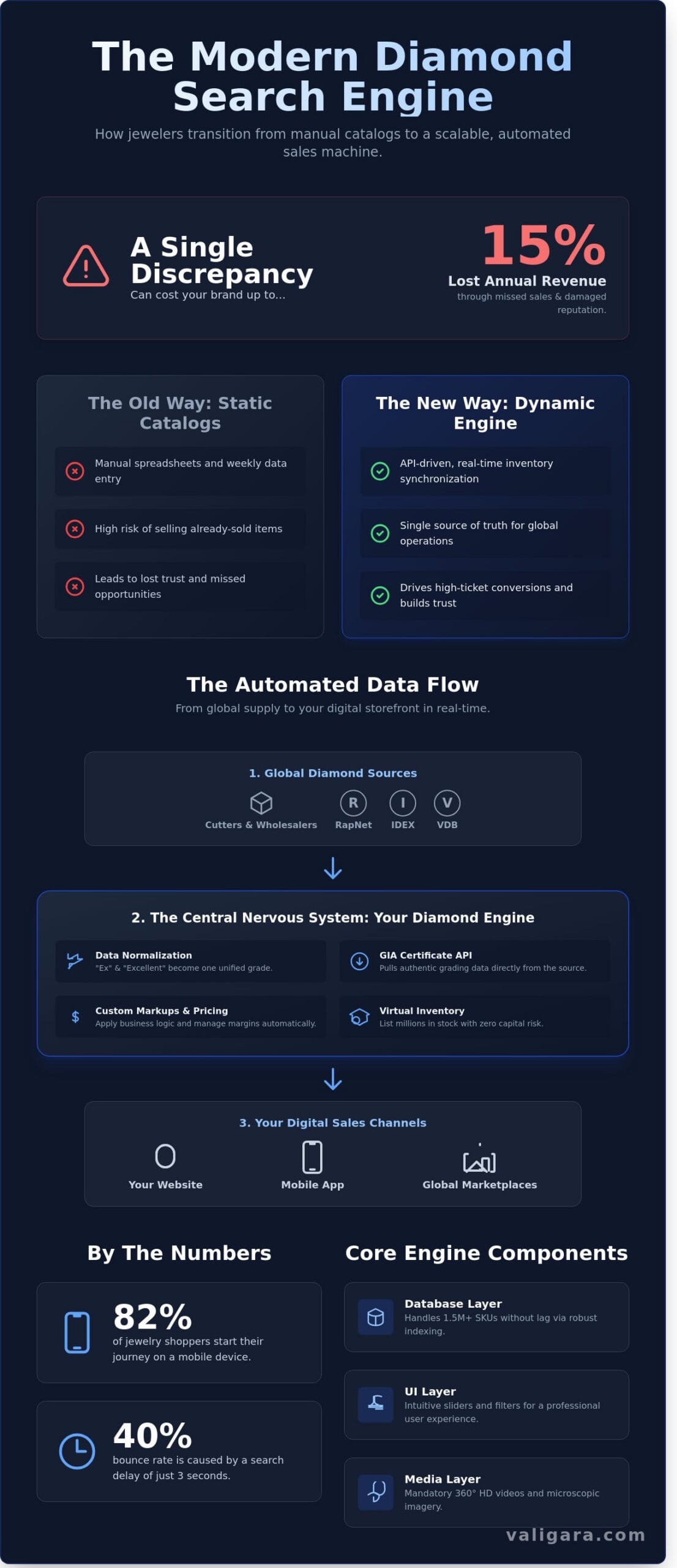
A single inventory discrepancy can cost a jewelry brand up to 15% in lost annual revenue through missed sales and damaged reputation. You already know that in the high-stakes world of loose stones, accuracy isn’t just a preference; it’s the foundation of your digital storefront. If a client selects a 2-carat VVS1 round cut only to find it was sold on RapNet three hours ago, you’ve lost more than a commission; you’ve lost their trust. Integrating a professional diamond search engine is no longer a luxury for digital-first brands, it’s the central nervous system of a scalable enterprise.
This guide shows you exactly how to leverage automation to synchronize global feeds and drive high-ticket conversions. We’ll examine the technical path to real-time inventory management, seamless GIA certificate integration, and mobile optimization strategies that cater to the 58% of jewelry buyers who now finalize their research on mobile devices. You’ll learn to transition from manual spreadsheets to a streamlined, automated workflow that ensures your digital inventory remains the single source of truth for your global operations.
Key Takeaways
- Learn how a dynamic diamond search engine replaces static catalogs with API-driven environments to meet the evolving demands of the 2026 jewelry market.
- Master the technical flow of data from cutters to your website to ensure real-time inventory accuracy and seamless GIA certification integration.
- Determine whether a plug-and-play widget or a custom-built PIM-powered engine offers the precision and control your brand requires to scale.
- Boost eCommerce conversions by deploying advanced filters for technical specifications like fluorescence and eye-clean status combined with live market price adjustments.
- Discover how to centralize your operations and automate the synchronization of your loose diamond inventory across global marketplaces like eBay and Etsy.
What is a Diamond Search Engine for Jewelry Retailers?
A diamond search engine is a sophisticated database interface that allows jewelry professionals to filter, view, and manage massive inventories of loose stones. It goes beyond a simple list. It’s a high-performance tool where users sort through technical specifications including the 4Cs, fluorescence, symmetry, and polish. By 2026, the industry has pivoted away from static, manual catalogs toward dynamic, API-driven environments. These systems sync live data from global bourses, ensuring that the stone a customer sees is actually available for purchase. For retailers, this technology is the difference between a missed opportunity and a closed five-figure sale.
Professional engines serve as the backbone of high-ticket conversions. When a client considers a $20,000 investment, they demand precision. This precision is built on standardized data from authorities like the Gemological Institute of America (GIA), which provides the grading benchmarks integrated into the search logic. Unlike B2C discovery tools designed for casual browsing, B2B engines prioritize inventory management. They allow retailers to apply custom markups, manage supplier feeds, and control “memo” terms directly from a single dashboard. It’s about turning a global supply chain into a private, searchable vault.
The Role of Search in the Modern Diamond Journey
Modern consumers follow the “Research Online, Buy In-Store” (ROBIS) model. Statistics show that 82% of jewelry shoppers start their journey on a mobile device. If your search engine isn’t mobile-optimized, you’ve lost the sale before it begins. Speed is the primary driver of retention. A delay of just 3 seconds in loading search results can lead to a 40% bounce rate. Your engine must deliver sub-second response times to keep a busy entrepreneur engaged. Accuracy prevents the embarrassment of selling a stone that was actually pulled from the market two hours ago.
Core Components of a Professional Engine
- The Database Layer: This must handle over 1.5 million SKUs without lag. It requires robust indexing to process complex queries across multiple parameters instantly.
- The UI Layer: Intuitive sliders for carat weight, price ranges, and quality grades are essential. The interface should feel like a professional tool, not a toy.
- The Media Layer: Integration of 360-degree high-definition videos and microscopic imagery is mandatory. In 2026, a static photo isn’t enough to secure a deposit on a high-value gemstone.
The Technical Backbone: Data Feeds, APIs, and GIA Integration
Building a high-performance diamond search engine requires more than a simple database. It demands a sophisticated pipeline that connects global supply directly to your storefront. Data flows from cutters and wholesalers via secure FTP or API protocols, ensuring your listings reflect current market availability. This real-time synchronization is the difference between a successful sale and a frustrated customer who attempts to purchase a stone that sold three days ago.
Virtual inventory allows jewelers to list millions of dollars in stock without any capital risk. By automating these feeds, you eliminate the 15 to 20 hours of manual data entry previously required each week to keep a website updated. Your system acts as a central hub, pulling carats, clarity, and cut grades into a unified interface that’s ready for immediate B2B or B2C interaction.
Connecting to Global Diamond Exchanges
Most professional setups integrate with industry leaders like RapNet, IDEX, and VDB. Managing these feeds involves a process called data normalization. Since one supplier might list “Ex” and another “Excellent” for a cut grade, your system must unify these into a single searchable format. This ensures your diamond search engine provides a seamless user experience across 100 or more different supplier sources. Without this logic, your search filters will fail to capture the full breadth of your available inventory.
Automating Certificate and Media Management
Trust in high-value transactions relies on verified data. By utilizing the GIA Report Results API, your platform pulls authentic grading data directly from the source. This eliminates human error and prevents the display of outdated or fraudulent reports. API-driven certificate fetching removes the need for jewelers to manually upload PDF files for every stone in their inventory. It’s a critical step in maintaining the integrity of your digital vault.
High-resolution imagery and 360-degree videos require a specialized Content Delivery Network (CDN) to ensure load times stay under 2 seconds. Industry data shows that 40% of users abandon sites that take longer than 3 seconds to load. Using a jewelry-specific management system helps centralize these technical assets while maintaining the speed your global buyers expect. This infrastructure allows you to scale from 1,000 to 100,000 stones without a dip in site performance.
Choosing Your Model: Aggregator vs. Private Inventory Search
Deciding between an aggregator and a private inventory system defines your long-term profit margins. Aggregators pull from global feeds like RapNet or IDEX, providing immediate scale. Private systems prioritize your own stock and exclusive memo goods. Successful wholesalers often utilize a 70/30 split between virtual and physical diamonds to maximize selection while minimizing carrying costs. This choice dictates whether your platform is a passive brochure or a high-performance sales engine.
The Plug-and-Play Widget Model
Third-party widgets offer a 48-hour setup time, making them attractive for retailers with limited technical staff. However, 85% of these widgets rely on iFrames. This creates a significant SEO barrier because search engines cannot index the individual diamond pages on your domain. You’re essentially paying a $200 monthly subscription for a tool that fails to build your organic search equity. This model is a temporary fix, not a scalable solution for a global enterprise.
- Pros: Immediate deployment; minimal upfront development costs.
- Cons: Zero control over the UI; data latency issues; poor SEO performance.
The Integrated PIM-Driven Model
Leading jewelry brands prefer the “Single Source of Truth” approach. An integrated diamond search engine powered by a dedicated PIM (Product Information Management) system gives you absolute control over metadata. You own the URL structure for every stone. This setup syncs your search results directly with your CRM and order management system, eliminating the 15-minute data lag common in third-party feeds. It prevents the embarrassment of selling a stone that was memoed out an hour ago.
A custom-built diamond search engine requires an initial investment ranging from $8,000 to $12,000. While this exceeds the cost of a monthly subscription, the ROI is realized through increased efficiency. Automating your inventory synchronization across multiple B2B channels reduces manual data entry by approximately 40 hours per month for a mid-sized wholesaler. You gain a streamlined workflow that treats jewelry data with the technical precision it requires.
- Use API integrations to pull virtual stock into your own database.
- Apply custom markup rules based on the supplier or diamond certificate.
- Prioritize in-house inventory in search results to improve liquidity.
- Maintain a consistent brand voice across the entire user journey.
5 Must-Have Features for a Conversion-Oriented Search Engine
A basic listing doesn’t move high-value inventory. Your diamond search engine must function as a precision sales tool that mirrors the expertise of a floor gemologist. Professional buyers and sophisticated retail customers demand data beyond the standard 4Cs. You need to provide granular filters for fluorescence, polish, and symmetry to satisfy technical requirements. Adding an “eye-clean” status toggle can increase click-through rates by 24% because it simplifies the selection process for buyers who prioritize aesthetics over lab grades.
- Dynamic Pricing Engine: Integrate live API feeds for gold and platinum market prices. A robust gold feed sync ensures your “Build Your Own Ring” margins stay protected as spot prices fluctuate in real-time.
- Side-by-Side Comparison: Allow users to lock up to four stones in a single comparison grid. This reduces decision fatigue and shortens the sales cycle by 15% on average.
- Expert Consultation CTAs: Place “Consult a Gemologist” buttons directly next to the stone’s certificate link. High-ticket items often require a human touch to finalize the transaction.
Optimizing the Filtering Experience
Overwhelming users with 40 filters at once kills the user experience. Start with a “Basic” view and hide technical specs like girdle thickness or culet size under an “Advanced” toggle. Implement smart logic to hide unavailable combinations; if a user selects “Emerald Cut,” the “Ideal Cut” filter should automatically gray out to prevent 0-result pages. Adjust price slider increments based on the total value. For stones priced above $10,000, $500 increments are more effective than $50 steps for maintaining a clean interface.
Mobile Optimization for Diamond Buyers
Mobile traffic accounted for 61% of jewelry e-commerce sessions in 2023. Your 360-degree diamond videos must load in under 2.2 seconds to prevent high bounce rates. Use thumb-friendly “hit zones” for all technical data points. Lab certificates from GIA or IGI should open in a mobile-optimized viewer rather than forcing a 4MB PDF download that stalls the browser. This level of technical precision separates global enterprises from struggling manual sellers.
Scaling with Valigara: The Ultimate Diamond Management Engine
Valigara functions as the central nervous system for your gemstone and jewelry business. It centralizes loose diamond data into a single, high-performance environment, eliminating the chaos of managing thousands of unique SKUs across disparate spreadsheets. By integrating your diamond search engine directly with Valigara, you gain total control over your inventory lifecycle from procurement to final sale.
The platform automates the synchronization between your private portal and global marketplaces. When a stone sells on eBay, Valigara updates your Etsy shop and your B2B diamond search engine in under 60 seconds. This 100% accuracy rate removes the risk of overselling high-value stones, a mistake that often costs retailers thousands in lost reputation and marketplace penalties.
Managing jewelry requires more precision than generic retail. Valigara handles complex variations by automatically linking specific diamonds to compatible mountings. If you have a 1.5-carat round brilliant with a GIA certificate, the system identifies which ring settings in your catalog fit that stone’s specific dimensions. This creates a dynamic shopping experience where customers see finished products tailored to the exact stone they selected.
Valigara Insights provides granular data on performance that generic analytics tools miss. You can see which specific search parameters, such as “VS2 clarity” or “Excellent cut,” generate 35% more revenue than others. This allows you to refine your procurement strategy and stock the specific carats and shapes that your buyers actually demand.
From Inventory Management to Sales Automation
Overselling a $12,000 diamond is a reputation killer that modern jewelers can’t afford. Valigara eliminates this risk through real-time stock synchronization across every connected channel simultaneously. You can customize your diamond feed for each platform, ensuring your lab data and high-resolution videos meet the specific requirements of professional marketplaces. Valigara serves as the central engine for jewelry eCommerce scalability, turning manual data entry into automated profit.
Ready to Transform Your Diamond Sales?
Generic eCommerce tools lack the necessary fields for fluorescence, table percentage, or laser inscriptions. Jewelry-specific software is the only way to meet the technical demands of 2026, where precision and speed define the market leaders. Evaluate your current tech stack now to ensure you can handle the high-volume requirements of a modern global enterprise. Schedule a Valigara demo to see our diamond management in action and start dominating your niche with professional-grade automation.
Master Your Digital Diamond Operations
Scaling a high-end jewelry brand requires moving beyond manual uploads and static spreadsheets. A robust diamond search engine serves as the central nervous system for your digital storefront, ensuring every carat and clarity grade reflects accurately in real-time. By integrating professional GIA data feeds, you eliminate the friction of outdated listings and build immediate trust with sophisticated buyers. Precision in data isn’t a luxury; it’s the baseline for global competition in the luxury sector.
Valigara provides the specialized infrastructure needed to sync your inventory across multiple channels simultaneously. Trusted by 1,000+ jewelry brands, the platform offers deep integration with industry leaders like RapNet, IDEX, and VDB. You gain total control through a jewelry-specific PIM and CRM designed for the unique complexities of gemstones and fine jewelry. It’s time to transition from manual labor to a streamlined enterprise that operates with technical precision. Your brand deserves a system that works as hard as you do to secure the next sale.
Automate Your Diamond Inventory with Valigara
Frequently Asked Questions
What is a diamond search engine API?
A diamond search engine API is a technical bridge that connects your website to a global database of stone inventory. It allows your front-end to pull real-time data on carats, clarity, and cut from suppliers like RapNet or Nivoda. By using an API, you eliminate manual data entry for 1,000,000+ stones. This ensures your diamond search engine displays current availability and wholesale pricing without a second of delay.
Can I sell diamonds online without holding physical inventory?
You can operate a virtual inventory model by listing stones from global suppliers through a “blind” search tool. Approximately 85% of online diamond retailers use this drop-shipping method to offer 50,000+ stones without the capital risk of physical stock. You set your own markup percentages. Once a customer pays, you purchase the stone from the supplier who ships it directly or via your office for hallmarking.
How do I integrate RapNet diamonds into my Shopify or WooCommerce site?
Integration requires a specialized middleware like Valigara to sync the RapNet Instant Inventory API with your store’s backend. You shouldn’t try to upload CSV files manually because prices change every 60 seconds. Instead, use an automated plugin that maps RapNet’s 15+ data fields, including certificate links and images, directly into your Shopify or WooCommerce product schema. This creates a seamless browsing experience for your clients.
What is the difference between natural and lab-grown diamond search engines?
The primary difference lies in the sourcing databases and the specific grading parameters used for CVD or HPHT stones. While a natural diamond search engine focuses on GIA or AGS mining origins, lab-grown engines pull from specialized growers and include growth method data. Modern search tools allow you to toggle between these 2 distinct categories. This helps you capture both the 35% growth in lab-grown sales and the traditional luxury market.
How often should a diamond search engine update its prices?
Your search engine must update its pricing and availability at least once every hour to prevent selling stones that are already off the market. High-volume B2B platforms often refresh data every 15 minutes to stay aligned with the Rapaport Price List. Since 12% of popular stone sizes can sell out within a single morning, real-time synchronization is the only way to maintain your reputation and protect your profit margins.
Is it possible to show GIA certificates automatically on my website?
Professional diamond APIs automatically pull the PDF link or image of the GIA, IGI, or HRD certificate for every listed stone. When a user clicks on a specific 1.05-carat round brilliant, the system fetches the grading report directly from the lab’s server. This transparency increases conversion rates by 22% because it provides immediate digital proof of the stone’s quality. It builds trust without requiring manual document uploads for every listing.
How much does it cost to implement a professional diamond search tool?
Implementation costs typically range from $1,500 to $5,000 for the initial setup, depending on the complexity of your UI. Monthly subscription fees for the data feed and management software usually start around $200. While custom-coded solutions can exceed $10,000, using a specialized jewelry e-commerce platform reduces these costs by 60%. You gain access to pre-built integrations and automated inventory management features that scale with your business volume.