
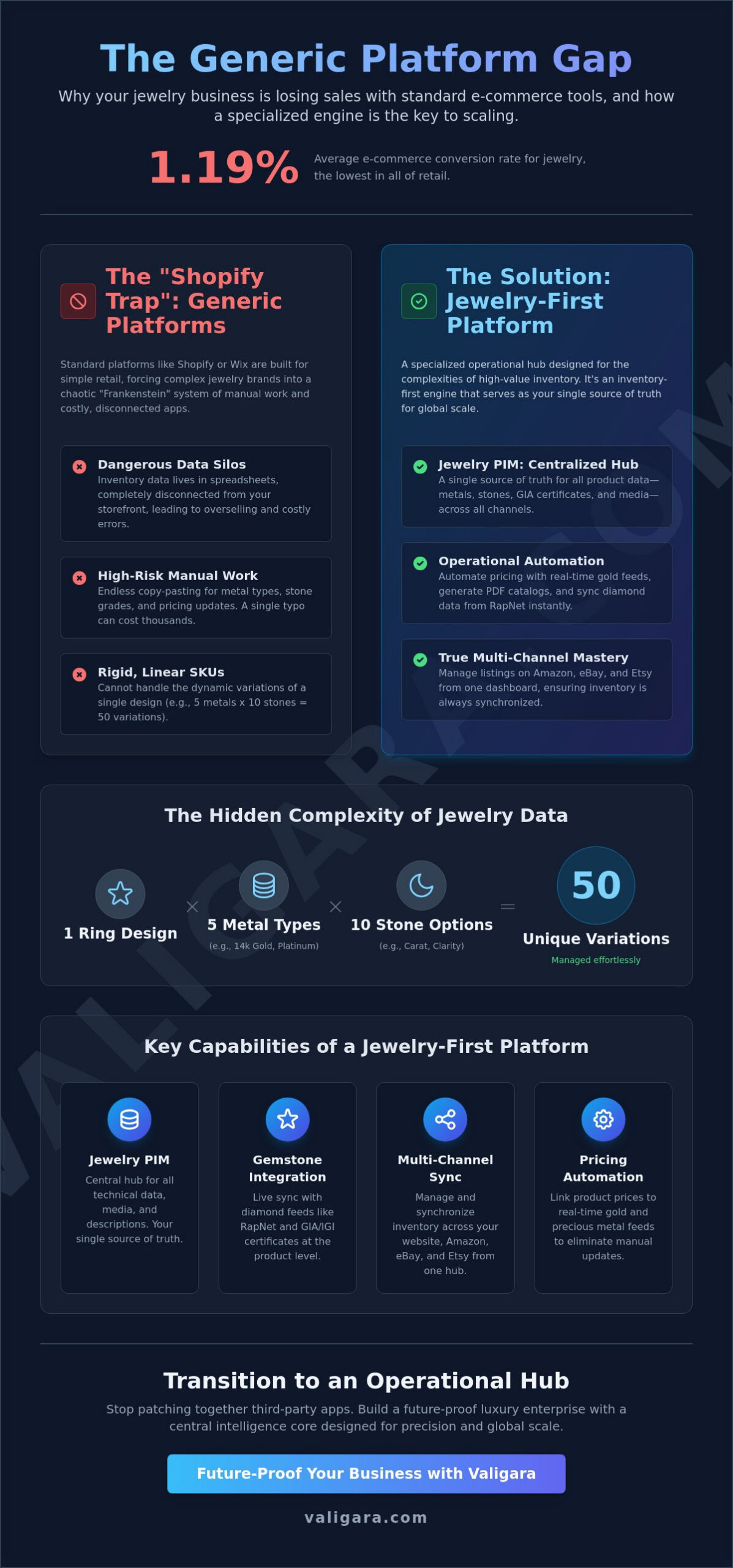
With an average e-commerce conversion rate of just 1.19%, the lowest in all of retail, your choice of an ecommerce platform for jewelry business is no longer just a technical detail; it’s a high-stakes survival strategy. You already know the exhaustion of manual data entry for every metal variation and the constant risk of overselling a one-of-a-kind piece across eBay, Etsy, and Amazon. It’s a common struggle for luxury brands trying to force complex, high-value inventory into generic digital boxes that don’t understand the difference between 14k gold and platinum.
This guide reveals why a specialized, jewelry-first operational brain is the only way to scale a professional brand in 2026. You’ll learn how to transition from manual workflows to a streamlined, global enterprise that handles gemstone certifications and carats with technical precision. We’ll examine the essential tools for automated multi-channel listing and real-time gold feed synchronization that turn your inventory into a single source of truth. It’s time to move beyond basic storefronts and build a business designed for precision, speed, and global scale.
Key Takeaways
- Understand why generic storefronts create data silos and how to close the “Generic Platform Gap” using jewelry-specific data architecture.
- Identify the critical capabilities of a specialized ecommerce platform for jewelry business, focusing on integrated Diamond and Gemstone Management modules.
- Learn the strategic difference between simple listing and true multi-channel management across global marketplaces like Amazon, eBay, and Etsy.
- Automate high-risk manual tasks through real-time Gold Feed Sync and professional PDF catalog generation to streamline your B2B operations.
- Transition from a chaotic stack of third-party apps to a centralized operational hub that serves as the core intelligence of your luxury enterprise.
The Shopify Trap: Why Generic eCommerce Platforms Fail Jewelry Brands
Most entrepreneurs select a generic ecommerce platform for jewelry business because the initial setup feels effortless. They see a beautiful template and assume the back-end will support their growth. This is the “Generic Platform Gap.” Standard software like Shopify or Wix is engineered for high-volume, low-complexity retail like apparel or electronics. These platforms prioritize the “buy button” over the intricate data architecture required to manage luxury goods. When your business scales, you quickly discover that these tools lack the specialized fields needed for precious metals and gemstones.
Relying on a generic system forces you into a cycle of manual workarounds. You end up managing your most sensitive data in spreadsheets, then copy-pasting that information into your storefront. This creates dangerous data silos where your actual inventory doesn’t match your online listings. A single typo in a metal weight or a stone grade can lead to a massive financial loss or a legal dispute. Generic platforms treat your inventory as a static list of items, whereas a professional jewelry enterprise requires an inventory-first management engine that understands the fluctuating value of your materials.
The hidden costs of these “simple” platforms are staggering. To make them work for jewelry, you must stack dozens of third-party apps for pricing, variations, and image management. Each app adds a monthly fee and another point of potential failure. Instead of a streamlined operation, you’re left with a “Frankenstein” system that requires constant manual oversight just to keep the lights on.
The Problem with Standard SKU Structures
Standard SKU logic is linear and rigid. It doesn’t account for the fact that a single ring design might have five metal types and ten center stone options. That creates 50 unique variations for one product. Updating prices across those 50 variations manually every time the gold market fluctuates is a recipe for burnout. Standard e-commerce platforms fail to handle jewelry sets and components because they view every item as a finished, static good rather than a dynamic assembly of high-value parts.
The Hidden Complexity of Jewelry Data
Luxury consumers demand technical precision. They aren’t looking for “Small” or “Large”; they’re looking for specific carat weights, metal purities, and gemstone clarity grades. When you use generic software, these critical specifications are often buried in flat text descriptions where search engines can’t index them. This hurts your SEO and diminishes customer trust. For an industry that respects the history and cultural significance of jewelry, your digital presentation must reflect that same level of craftsmanship. Without native GIA or IGI certificate integration at the product level, your platform treats a $10,000 diamond like a disposable fashion accessory.
Core Features of a Jewelry-First eCommerce Platform
Scaling a luxury brand requires more than a sleek front-end. It demands a specialized architecture that serves as the central intelligence of your brand. A professional ecommerce platform for jewelry business moves beyond simple content management to provide deep technical control over every component of your inventory. This shift from a generic storefront to an inventory-first system is what separates a hobbyist from a global enterprise.
The foundation of this transition is the Jewelry PIM (Product Information Management). This is your single source of truth. Unlike standard databases that treat products as flat files, a Jewelry PIM handles the complex relationships between metals, stones, and labor. It centralizes high-resolution media, including 360-degree views and videos, ensuring that your most valuable assets are showcased with technical precision across every sales channel.
Jewelry PIM: The Foundation of Scale
A specialized PIM does what a standard database cannot: it automates the creation of product descriptions based on technical specifications. When you input the metal purity, stone weight, and clarity, the system generates accurate, SEO-optimized copy. This eliminates human error and ensures that your data remains consistent whether a customer is viewing your site or a third-party marketplace. It’s about maintaining authority through accuracy.
Diamond and Gemstone Management
High-end retail lives and dies by the quality of its stones. A jewelry-first platform integrates directly with diamond feeds like RapNet, allowing you to sync live inventory into your catalog. This capability is essential for displaying digital GIA or HRD certificates instantly, which is a critical step in building buyer confidence for high-ticket transactions. You can also manage your inventory at a granular level, distinguishing between unique, certified stones and gemstone parcels used for pavé settings.
Managing these high-value components requires a platform that understands the traditional craftsmanship of the trade. While jewelry industry employment data reflects the ongoing need for skilled professionals, your software should handle the heavy lifting of data tracking. This allows your team to focus on design and sales rather than manual inventory updates. Tracking loose stones versus finished pieces ensures you never lose sight of your most valuable assets, providing a clear path from raw material to sold masterpiece.
Finally, selling luxury isn’t a one-time transaction; it’s about high-ticket relationship building. An integrated Jewelry CRM tracks customer preferences, anniversary dates, and previous purchases. This specialized data allows for personalized marketing that generic CRM tools simply don’t support. If you’re ready to centralize your operations and eliminate the chaos of manual tracking, a specialized jewelry management hub can transform your workflow into a streamlined, professional enterprise.
Multi-Channel Mastery: Dominating Marketplaces from a Single Hub
Simply putting items on a marketplace isn’t the same as managing a multi-channel enterprise. Most jewelers start by manually uploading photos to Etsy or eBay, only to realize that maintaining those listings is a full-time job. A professional ecommerce platform for jewelry business acts as the central intelligence hub, pushing data out rather than requiring you to pull it into every individual site. This centralized control is the only way to dominate global marketplaces without drowning in administrative labor.
Each marketplace has its own DNA. Amazon demands strict attribute mapping; Etsy rewards storytelling and specific tags; eBay requires technical precision in item specifics. A specialized hub maps your Jewelry PIM data to these unique requirements automatically. You can bulk list thousands of SKUs using templates that understand jewelry-specific nuances like metal purity or stone clarity. This automation extends to international expansion, where the system handles currency conversion and even regional spelling differences, such as switching between “Jewelry” and “Jewellery” to match local search behavior.
Automated Listing Across Global Marketplaces
The manual mapping of attributes is where most scaling efforts fail. When you use an automated system, your technical specifications—like carat weight or metal type—are translated into the specific language each marketplace speaks. This ensures your products appear in the correct filtered search results, which is where the majority of high-value conversions happen. By using jewelry-specific templates, you maintain a consistent brand voice across Walmart, Amazon, and specialized jewelry marketplaces while meeting the technical demands of each platform.
Real-Time Inventory and Price Synchronization
Real-time synchronization is your brand’s primary defense mechanism. In the luxury sector, overselling a one-of-a-kind piece isn’t just a mistake; it’s a reputation killer. If a ring sells on your website, every other marketplace listing must reflect that change instantly. A five-minute lag in synchronization can lead to a cancelled order, which triggers marketplace penalties and destroys customer trust. Automated stock synchronization protects your brand reputation by ensuring that what the customer sees is exactly what is available in your vault.
Beyond inventory, your pricing must remain dynamic. When the gold market moves or diamond prices shift, a manual update across four or five channels is impossible to execute with precision. A specialized platform uses a Gold Feed Sync to adjust your prices globally in seconds. By centralizing orders and customer communications into a single dashboard, you eliminate the need to log into multiple portals. You respond faster, ship more accurately, and maintain the white-glove service that luxury buyers expect, regardless of where they found your brand.
Operational Automation: Scaling Without the Manual Labor
Scaling a luxury brand is often hindered by the weight of manual administration. While some competitors suggest maintaining spreadsheets to stay organized, this is a non-scalable manual process that invites human error. A professional ecommerce platform for jewelry business serves as the core intelligence of your operation, replacing fragmented tasks with high-tech automation. By eliminating manual labor, you free your team to focus on high-value strategy and creative development rather than data entry.
Physical stock management is another area where generic tools fall short. Integrated barcode and tag printing allows you to move items from the vault to the customer with technical precision. Every piece is tracked from the moment it’s entered into your Jewelry Inventory Management system. This level of control extends to your outreach through marketing automation tailored specifically for luxury purchase cycles. You aren’t just sending generic emails; you’re triggering communications based on specific jewelry data like metal types or gemstone preferences discovered through your Jewelry CRM.
Gold Feed Sync and Dynamic Pricing
In 2026, a Gold Feed Sync is a non-negotiable requirement for protecting your margins. Precious metal prices fluctuate constantly; if your pricing remains static, you’re either losing profit or pricing yourself out of the market. Automation integrates real-time market data directly into your catalog. You can set sophisticated pricing rules based on metal weight and current spot prices, ensuring your storefront reflects the true value of your inventory at all times. This eliminates the “pricing day” headache where owners spend hours manually adjusting SKUs across multiple channels.
B2B and Wholesale Tools
Wholesale operations often suffer from the same manual bottlenecks as retail. A specialized platform provides B2B Sales Tools that simplify complex relationships. You can create password-protected portals for wholesale buyers, allowing them to view tiered pricing and place bulk orders without direct intervention. One of the most significant efficiency gains comes from PDF Catalog Generation. Instead of spending days designing line sheets, you can generate professional, high-resolution catalogs in seconds. These documents pull live data from your Jewelry PIM, ensuring that your wholesale clients always see accurate specifications and availability. If you’re ready to stop the manual grind, it’s time to automate your jewelry operations with a system built for the serious business of scale.
The Valigara Advantage: Future-Proofing Your Jewelry Enterprise
Scaling a luxury brand requires a transition from reactive management to proactive automation. Many jewelers find themselves trapped in a “Shopify + Apps” cycle, where fragmented tools struggle to communicate. This creates friction and limits your ability to expand globally. Choosing Valigara as your ecommerce platform for jewelry business replaces this chaos with a centralized hub designed by industry experts. It acts as the core intelligence of your operation, ensuring that your Jewelry PIM, inventory, and sales channels work in perfect synchronization.
Beyond back-end management, the front-end experience must be equally specialized. The Valigara Vite eCommerce Website builder offers a high-performance alternative to generic CMS platforms. It’s optimized specifically for jewelry retail, providing the speed and technical infrastructure necessary to showcase high-resolution 360-degree views and complex product variations without lag. This specialized approach ensures your digital presence is as refined as the craftsmanship of your physical pieces. By moving to an inventory-first system, you transition from a manual workflow to a streamlined, global enterprise.
All-in-One vs. Fragmented Systems
The efficiency gains of a centralized system are immediate. By managing your Jewelry CRM, PIM, and Multi-channel Listing Automation through a single login, you eliminate the data silos that lead to human error. This consolidation significantly reduces IT overhead and ends the frustration of software subscription fatigue. For high-volume sellers, this reliability is the foundation of global scalability. You can manage thousands of SKUs and fulfill orders across multiple continents with the quiet confidence that your data is accurate and your systems are secure. It’s a professional solution for those who value time and accuracy above all else.
Getting Started: Onboarding and Implementation
Transitioning to a professional management engine doesn’t have to be disruptive. Unlike generic tech support that lacks industry context, our specialized onboarding team understands the nuances of gemstone parcels, metal variations, and diamond certifications. We prioritize a seamless data migration process, moving your complex jewelry catalog into the Valigara hub without losing critical specifications or media assets. This expert-led implementation ensures you hit the ground running with a system that’s ready to scale from day one.
The path to business scalability is built on precision and ease. It’s time to stop fighting with generic tools and start growing with a partner that speaks your language. Schedule a demo with Valigara to see the jewelry-first difference and take control of your digital enterprise today.
Take Command of Your Global Jewelry Enterprise
The era of managing a luxury brand through fragmented spreadsheets and generic apps is over. Scaling in 2026 requires a specialized hub that handles the technical complexity of carats, metal purities, and global marketplace requirements without constant manual intervention. By adopting an inventory-first approach, you eliminate the risk of overselling and ensure your pricing reflects real-time market fluctuations. It’s about moving from a simple storefront to a high-performance operational hub that serves as the brain of your business.
Selecting the right ecommerce platform for jewelry business is the most critical decision for your brand’s future growth. Valigara was founded by industry experts in 2009 and now manages millions of jewelry SKUs globally. With specialized GIA and Gold Feed integrations, it provides the technical precision you need to dominate the luxury market with confidence. It’s time to transition from manual labor to high-tech automation and claim your place in the global market. Your enterprise deserves a system as refined as the jewelry you create.
Automate your jewelry business with Valigara
Frequently Asked Questions
What is the difference between generic e-commerce and a jewelry-specific platform?
Generic platforms focus on simple retail, while jewelry platforms handle technical data like metal weight and stone clarity. A specialized ecommerce platform for jewelry business provides built-in fields for jewelry-specific attributes that standard systems lack. This eliminates the need for manual workarounds and third-party apps to manage precious materials. It’s the difference between a basic digital storefront and a professional management engine.
Can I sync my jewelry inventory across Etsy, eBay, and Amazon simultaneously?
You can synchronize your entire inventory across global marketplaces from a single dashboard. Specialized software maps your product data to the unique requirements of each channel automatically. This centralized control ensures that a sale on one platform updates your stock levels everywhere in real-time. It’s the most efficient way to maintain a global presence without increasing your administrative workload or risking data silos.
How does a jewelry eCommerce platform handle gold price fluctuations?
The platform uses a Gold Feed Sync to integrate live market data directly into your pricing engine. You can establish automated rules that adjust your retail prices based on current spot prices and specific metal weights. This protects your margins during market volatility and removes the need for manual price updates across thousands of SKUs. Your storefront remains accurate and profitable without constant oversight from your team.
Do I need a separate PIM if I already use Shopify for my jewelry business?
Shopify’s native database isn’t designed to handle complex jewelry specifications or component-level data. A Jewelry PIM acts as the central intelligence hub, feeding enriched data into your Shopify storefront while managing technical details Shopify can’t store. This setup allows you to keep your preferred front-end while gaining the robust back-end control required for professional jewelry management. It’s a necessary upgrade for any scaling brand.
Can I manage GIA and diamond certifications within the platform?
You can manage GIA, IGI, and HRD certifications directly at the product level. The system allows you to upload and display digital certificates, building immediate trust with high-ticket buyers. By integrating these documents into your catalog, you provide the technical transparency required for luxury sales. This feature ensures that every certified stone in your inventory is backed by its official documentation online, which is critical for conversion.
Is it possible to automate jewelry PDF catalogs for wholesale?
Automated PDF catalog generation allows you to create professional line sheets in seconds using live inventory data. You can select specific collections or items and generate a high-resolution document for B2B clients immediately. This eliminates the days of manual design work typically required for wholesale outreach. Your catalogs will always reflect current pricing and availability, ensuring your wholesale partners have accurate information for their purchasing decisions.
How does multi-channel software prevent jewelry overselling?
Multi-channel software uses real-time inventory synchronization to lock or remove listings across all platforms the moment a sale occurs. If a one-of-a-kind ring sells on your website, the system instantly updates Etsy, eBay, and Amazon to reflect zero stock. This automated safeguard protects your marketplace seller ratings and prevents the reputational damage caused by cancelled orders. It provides the reliability needed for managing high-value, low-volume inventory across a global network.
What is the best way to manage complex jewelry SKUs and variations?
The most effective method is using an ecommerce platform for jewelry business that supports multi-level SKU structures for metals and stones. Instead of creating individual products for every variation, you manage one parent product with dynamic attributes. This system understands that a single design can have dozens of combinations, allowing you to track each component’s stock and price accurately. It’s the only way to manage large catalogs with technical precision and ease.