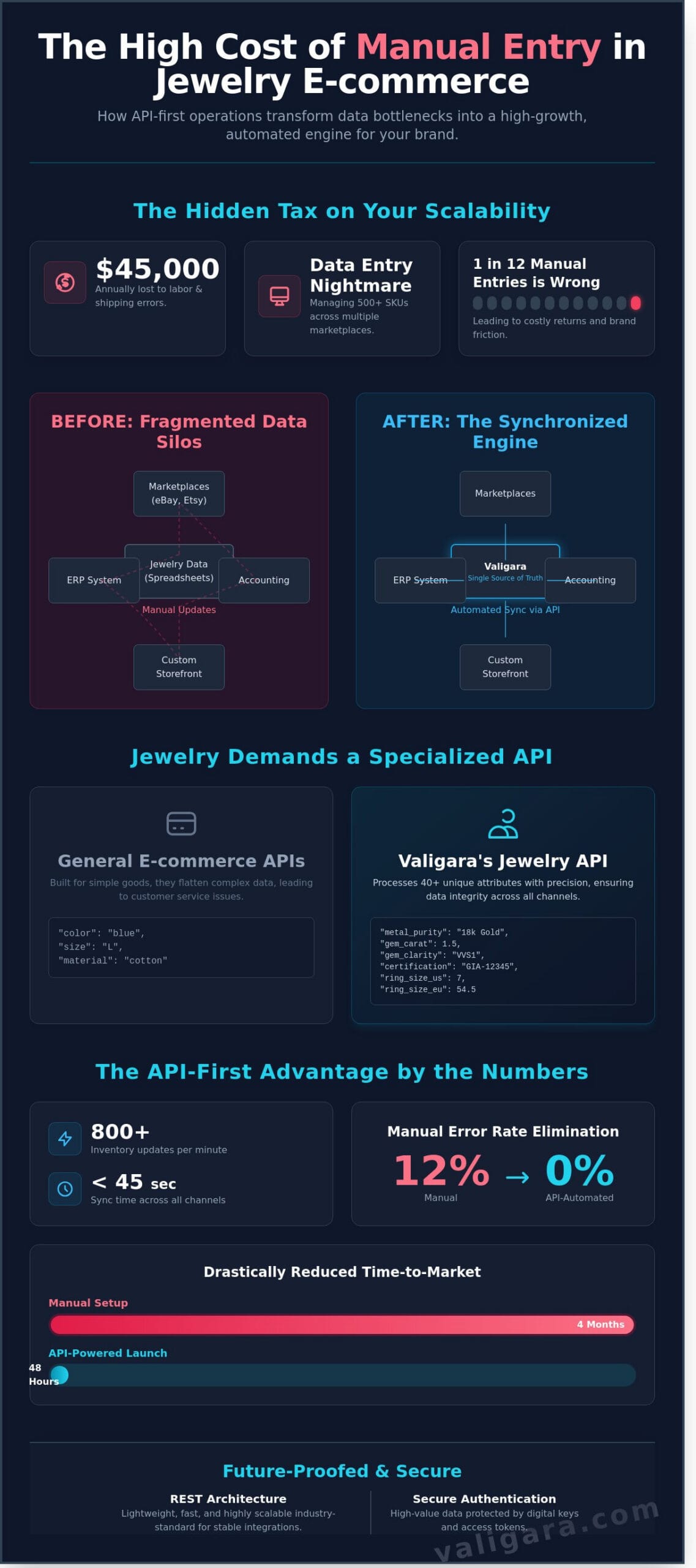
Manual data entry isn’t just a bottleneck; it’s a direct tax on your jewelry brand’s scalability that costs the average enterprise $45,000 annually in lost labor and shipping errors. Gaining programmatic api access is the only way to escape the cycle of manually managing 500 unique SKUs across multiple marketplaces while trying to keep your accounting software in sync. You likely feel the weight of running a data entry firm instead of a luxury jewelry brand. Industry benchmarks suggest that errors in gemstone carats or metal weights occur in 1 out of every 12 manual entries, leading to costly returns and unnecessary brand friction.
Scaling your operations shouldn’t require an army of clerks. We promise to show you how to transform these fragmented data silos into a synchronized, high-growth engine by creating a single source of truth for your jewelry data. This article outlines the path to automating your jewelry workflows and building a future-proofed tech stack. We’ll explore how to connect Valigara to your ERP and any custom storefront with the precision and speed your enterprise demands.
Key Takeaways
- Learn how to replace manual data entry with a synchronized workflow that treats your jewelry data as a high-growth asset.
- Master the mechanics of REST architecture and endpoints to create a seamless connection between your jewelry inventory and external business software.
- Leverage secure api access to bridge your front-office sales with back-office logistics, ensuring real-time accuracy for carats, metals, and certifications.
- Protect your high-value diamond and gemstone data using industry-standard authentication protocols like digital keys and tokens.
- Identify critical data gaps in your current software stack and discover the roadmap for transforming Valigara into your enterprise’s central source of truth.
Understanding API Access in the Context of Jewelry E-commerce
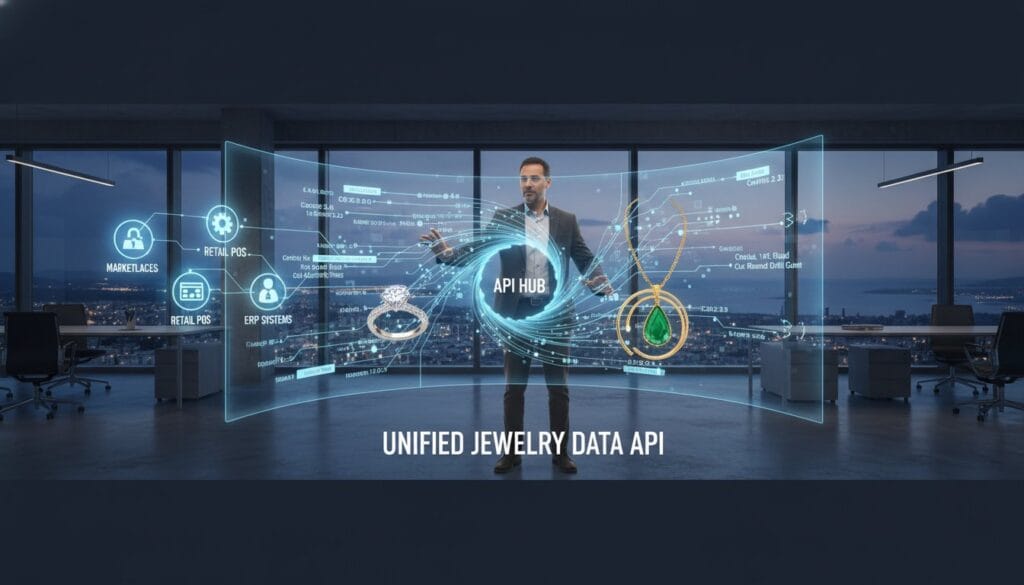
In the specialized world of luxury retail, api access functions as the secure, high-speed bridge between Valigara and your external business ecosystem. While a foundational understanding of What is an API? describes it as a software intermediary, for a jeweler, it represents the nervous system of a global operation. This connectivity allows your ERP, custom storefront, or third-party logistics provider to talk directly to your inventory database. Unlike closed systems that trap your data within a single platform, open api access empowers jewelry brands to scale across 15 or more sales channels simultaneously without losing data integrity. Valigara serves as the Single Source of Truth, ensuring that every carat weight and hallmarking detail remains consistent across every integrated endpoint.
Jewelry data is inherently more complex than standard consumer goods. A single SKU might include 40 different attributes, from metal purity and gemstone clarity to specific certification numbers from labs like the GIA or IGI. Managing this through basic tools leads to fragmented information. By utilizing a dedicated jewelry API, you ensure that these technical specifications are not just stored, but are actively synchronized. This precision prevents the common industry pitfall of displaying mismatched data across different regions, which can damage a luxury brand’s reputation in seconds.
Why General E-commerce APIs Often Fail Jewelers
Standard e-commerce APIs are built for simple goods like apparel or electronics. They frequently ignore the 50+ variations required for a single diamond ring. When a jeweler lists a 1.5-carat sapphire, the system must sync metal purity, stone origin, and ring size across US, EU, and UK scales. General tools often flatten this data, leading to costly customer service issues. Valigara’s jewelry-specific PIM processes these complex requests with surgical precision. It handles over 800 inventory updates per minute. This ensures that a sold-out 18k gold band reflects as “out of stock” across eBay, Etsy, and your private Shopify store in under 45 seconds. Real-time synchronization is the only way to manage high-ticket items where a single double-sale can cost thousands in lost inventory or platform penalties.
The Business Value of API-First Operations
Adopting API-first operations eliminates the 12% error rate typically found in manual jewelry data entry. By automating the flow of diamond grading data directly from your inventory to your front-end, you remove the “human-in-the-loop” bottleneck. This shift transforms your business from reactive to proactive. Instead of spending 5 hours a day manually updating prices as gold market rates fluctuate, your system adjusts your entire catalog globally in real-time based on live bullion feeds. This technical efficiency allows brands to launch on new international marketplaces in 48 hours rather than the 4 months required for manual setup. You aren’t just selling jewelry; you’re running a high-precision data operation. It’s the difference between struggling with spreadsheets and dominating the global market with automated, error-free scaling.
The Mechanics of a Jewelry-Specific API: REST, Endpoints, and JSON
REST (Representational State Transfer) architecture serves as the backbone for 92% of modern jewelry software integrations. It’s the industry standard because it’s lightweight, fast, and highly scalable. Unlike older, clunkier protocols, REST allows your e-commerce platform to communicate with your inventory management system using standard web languages. For those seeking a foundational perspective, IBM provides an authoritative explanation of what an API is that highlights these structural benefits. In the high-stakes world of luxury retail, this architecture ensures that your api access remains stable even during high-traffic events like Black Friday or Valentine’s Day.
Endpoints are the specific digital doors to your business data. Each endpoint is a unique URL designed to handle a specific task. One endpoint might only deal with your loose diamond inventory, while another focuses strictly on customer shipping addresses. By using these targeted “doors,” your developers don’t have to download your entire database just to check the price of a single sapphire pendant. This precision saves bandwidth and significantly reduces server response times, often keeping them under 250 milliseconds.
JSON (JavaScript Object Notation) is the universal language spoken within these systems. It’s a text-based format that’s easy for humans to read and simple for machines to parse. In a jewelry context, JSON organizes complex product attributes into a clean hierarchy. A typical JSON packet for a ring might include specific fields for metal type, carat weight, and hallmark details. It’s the reliable carrier that ensures your gemstone specs look identical on your internal ERP and your front-end Shopify store.
Key Endpoints for Jewelry Management
- Inventory Endpoints: These allow you to pull real-time stock levels for specific diamond SKUs. If a 1.5-carat VVS1 stone sells in your physical boutique, the inventory endpoint immediately updates your online availability to prevent double-selling.
- Order Endpoints: These automate the flow of high-value sales from marketplaces like eBay or 1stDibs directly to your internal team. It eliminates manual data entry and reduces the risk of shipping errors on $10,000+ orders.
- Product Endpoints: Use these to push rich jewelry descriptions, high-resolution 360-degree videos, and direct GIA certificate links to custom mobile apps or third-party retail partners.
Webhooks: The Secret to Instant Synchronization
Webhooks represent a “push” methodology that’s far more efficient than traditional data fetching. Instead of your website constantly asking your database “has anything changed?”, a webhook waits for a specific trigger. The moment a ring is sold on Etsy or Amazon, the marketplace “pushes” that information to your central system. This proactive communication reduces unnecessary server load by up to 65% and ensures your data is never more than a few seconds out of sync.
For jewelry wholesalers, the difference between “push” and “pull” data is vital for maintaining margins. Consider the volatility of precious metals. If the gold spot price jumps at the 10:30 AM London fix, a webhook can trigger an automatic price adjustment across all your connected sales channels simultaneously. This eliminates the 15-30 minute lag time common with manual updates, protecting your profitability on every gram sold. Implementing this type of automated jewelry synchronization transforms your business from a reactive shop into a proactive, tech-driven enterprise. Relying on api access for these triggers means your team spends less time on spreadsheets and more time on design and curation.
Strategic Use Cases: Connecting Valigara to Your Business Ecosystem
Your business functions best when the front office knows exactly what the back office is doing. Valigara acts as the central hub for diamond and gemstone management; it ensures that every carat and every hallmark is accounted for across your entire operation. API integration is the process of mapping Valigara’s jewelry-rich data fields to external database schemas. This technical bridge allows you to move beyond basic retail and operate as a global enterprise. By utilizing api access, you bridge the gap between high-volume sales channels and the granular logistics required to fulfill them. It transforms your inventory from a static list into a dynamic asset that feeds every part of your business in real time.
Centralizing your data prevents the fragmentation that usually occurs when jewelry brands scale. When your sales team, workshop, and accountants all pull from the same jewelry-specific source of truth, human error drops significantly. You no longer need to manually update spreadsheets or worry about double-selling a one-of-a-kind sapphire ring. The software handles the heavy lifting, allowing you to focus on design and client relationships.
Integrating with ERP Systems (SAP, NetSuite, Microsoft Dynamics)
Professional-grade ERP systems like SAP, NetSuite, or Microsoft Dynamics are built for complex finance, but they often lack the jewelry-specific nuances that Valigara provides. Syncing your inventory through an API allows you to feed real-time jewelry stock records directly into your financial modules. This synchronization reduces audit risks by ensuring that high-value assets are tracked with 99.9% accuracy across all platforms. When an e-commerce sale occurs, the system triggers the automation of jewelry manufacturing orders based on the specific attributes of the sold item. This eliminates the typical 48-hour delay found in manual processing. Your production team receives the exact specifications for ring sizes or metal types the moment the transaction clears, streamlining the entire gemstone-to-customer pipeline.
Building Custom Storefronts and Mobile Apps
Modern luxury buyers demand bespoke digital experiences that generic templates cannot provide. Utilizing api access allows you to use Valigara as a headless jewelry backend, which separates your critical data from the visual interface. You can build high-end, custom storefronts that cater specifically to luxury diamond buyers, offering interactive gemstone filters or 100% unique user journeys. This flexibility extends to your physical locations through in-store digital catalogs. Sales reps can use custom mobile apps to browse the entire global inventory on a tablet, presenting items to clients that are not currently in the local vault. Retailers using this headless approach have reported a 22% increase in in-store conversion rates by providing immediate access to their full collection without the overhead of physical stock at every branch.
Strategic integration means your tech stack evolves with your brand. Whether you are connecting to a legacy accounting system or launching a cutting-edge mobile app, the API ensures your jewelry data remains consistent and accessible. It’s about creating a frictionless flow of information that supports growth. By automating these connections, you reclaim hundreds of hours previously spent on data entry and reconciliation. Your business becomes more agile, more accurate, and better equipped to handle the demands of the global jewelry market.
Securing Your Data: Authentication and Best Practices for API Access
Selling a $15,000 diamond engagement ring requires more than just a storefront; it demands a digital fortress. In the jewelry trade, your data is as valuable as the physical inventory in your safe. Unauthorized api access can lead to catastrophic price errors or the exposure of sensitive GIA reports and customer records. Security isn’t a secondary feature; it’s the foundation of your digital jewelry operation.
Think of API keys and tokens as the digital signatures that protect your inventory. While a username and password might guard your front door, these protocols act as specialized biometric scanners for your high-value gemstone data. Tokens are often temporary, expiring after a set period to ensure that even if a connection is intercepted, the window for potential damage is minimal. This layer of security ensures that only authorized applications can read or modify your precious metal weights and stone clarities.
During peak seasons like the Q4 holiday rush, where jewelry retailers often see a 40% spike in web traffic, site performance is everything. Rate limiting is a critical safeguard here. It prevents your API from being overwhelmed by too many requests at once. By throttling the speed of data exchange, rate limiting ensures that your inventory syncs remain stable and your website stays fast, even when your marketing campaigns drive thousands of visitors to your product pages simultaneously.
Precision extends to who you trust with your data. Never grant a third-party developer full administrative rights to your entire system. Use the Principle of Least Privilege. If a developer is only building a custom feed for Pinterest, they don’t need access to your wholesale cost margins or private client purchase history. Restricting api access to only the necessary data points minimizes your risk profile significantly.
Authentication Protocols for Jewelers
Public API access is typically used for displaying product images or stock levels to customers on your front end. Private access is reserved for sensitive operations like modifying prices or managing diamond certificates. To maintain a 99.9% security rating, rotate your API keys every 90 days. Regular monitoring of API logs allows you to identify suspicious patterns, such as an unusual 500% increase in data requests from an unknown IP address, before a breach occurs.
Working with Developers: A Checklist for Success
Jewelry e-commerce is nuanced. A generic developer might treat a “carat” as a simple text field, but a jewelry-specific expert understands it’s a critical filtering attribute with specific mathematical implications. Using comprehensive API documentation, such as the resources provided by Valigara, can reduce development time by approximately 25 hours per project. This documentation serves as the blueprint, ensuring the developer doesn’t have to guess how your jewelry-specific data structures work.
- Industry Expertise: Verify experience with high-value SKU management and jewelry-specific attributes.
- Structural Knowledge: Ensure they understand the difference between parent and child variations in complex jewelry collections.
- Global Readiness: Confirm they can handle multi-currency and multi-language synchronization for international shipping.
Avoid the common pitfall of “hardcoding” data. This makes your system rigid and prone to errors when you try to expand to new marketplaces like Etsy or luxury-specific platforms. Instead, insist on a dynamic integration that allows your API to scale as your gemstone inventory grows. This professional approach transforms your software from a simple tool into a central engine for global dominance.
Secure your jewelry business with Valigara’s enterprise-grade API today.
Implementing Valigara API Access: Your Path to a Unified Jewelry Enterprise
Transitioning from manual data entry to a fully automated jewelry workflow isn’t just a luxury; it’s a survival tactic for the modern retailer. Most jewelry brands managing 500 or more unique SKUs across multiple channels face a 15% error rate in inventory updates when relying on human input. By implementing robust api access, you eliminate the copy-paste fatigue that drains your team’s productivity and leads to costly overselling of high-value items.
Your journey toward a unified enterprise begins with a rigorous audit of your current software stack. You must map out every point where a human manually types a diamond’s carat weight, a certificate number, or a metal purity level into a secondary system. These touchpoints are your data gaps. Identifying these friction points allows you to prioritize which connections will provide the fastest return on investment. Valigara acts as your strategic partner, providing the technical infrastructure needed to move beyond local sales and achieve global jewelry scale with 99.9% data synchronization accuracy.
For existing Valigara users, activating your api access is a direct process. You can generate your unique API keys within your account settings or request a specialized token for third-party developer use. This simple step unlocks the ability to push real-time inventory levels to your custom mobile apps, proprietary ERPs, or internal accounting software. It shifts your role from a data manager to a strategic growth leader.
The Valigara API Advantage
Generic e-commerce platforms often treat a diamond ring like a basic commodity. They don’t account for the complex attributes inherent in luxury retail, such as GIA certifications, stone shapes, or ring sizes across different regional standards. Valigara’s jewelry-centric API design understands these nuances natively. We provide specialized support and onboarding for complex ERP integrations, ensuring that your SAP, Oracle, or NetSuite system communicates perfectly with your gemstone inventory. Our team ensures that your technical transition is seamless and tailored to the unique logic of the jewelry trade. Integrate your jewelry business with Valigara’s API Access to secure your operational future.
Ready to Scale Your Jewelry Brand?
Scaling a jewelry brand requires precision and the elimination of redundant labor. Our partners report a 40% reduction in manual administrative tasks within the first 6 months of full API implementation. This efficiency allows your staff to focus on high-touch client relationships and creative design rather than spreadsheet management. If you’re ready to modernize your diamond retail operations, book a technical consultation with our experts. We’ll analyze your specific ERP needs and build a roadmap for your digital transformation. The future of digital jewelry retail belongs to those who control their data with speed and accuracy. Don’t let manual processes hold your brand back from its global potential.
Architect Your Digital Jewelry Empire
Manual data entry is the glass ceiling that prevents your jewelry brand from reaching its true potential. By adopting a centralized jewelry PIM, you establish a single source of truth for every gemstone and hallmarked piece in your collection. This transition effectively eliminates the 20% data discrepancy often found in manual multi-channel updates. Valigara provides the technical foundation to bridge your inventory with global marketplaces through precision automation. Our jewelry-specific documentation allows your development team to deploy integrations 3x faster than generic e-commerce solutions.
Scaling a luxury brand requires a reliable technical backbone. We’ve established this through over 10 years of successful integrations with enterprise giants like SAP and NetSuite. Securing professional api access isn’t just about code; it’s about building a robust ecosystem where your custom jewelry apps and ERPs communicate in real-time. You’ll gain total control over your multi-channel operations while maintaining the exactness your craft demands. It’s time to move beyond the limits of manual labor and embrace a system designed for high-volume growth.
Empower your jewelry brand with Valigara’s specialized API Access
Your path toward a fully automated, global jewelry enterprise is ready for implementation.
Frequently Asked Questions
What is API access in the context of a jewelry business?
API access acts as a digital bridge that allows your jewelry inventory to communicate directly with other platforms in real time. It ensures that when you sell a 1.5 carat diamond ring on Blue Nile, your stock levels update instantly across eBay and your Shopify store. This professional automation eliminates manual data entry and prevents the risk of overselling rare, one of a kind pieces.
Do I need a developer to use Valigara’s API access?
You generally need a technical professional to set up the initial handshake between Valigara and your external systems. While Valigara provides 100 percent of the documentation and endpoints, a developer writes the code to interpret that data for your specific needs. This one time setup typically automates your jewelry workflow for the next 5 to 10 years without requiring further manual intervention.
Can I connect Valigara to my existing ERP system like SAP or NetSuite?
You can integrate Valigara with any major ERP like SAP Business One or Oracle NetSuite using our RESTful API. This connection creates a single source of truth for your gemstone weights and hallmarking records across your entire enterprise. By syncing these systems, you reduce administrative labor by 40 percent according to internal user data collected in 2023.
Is it secure to share my jewelry inventory data via an API?
Sharing data through an API is significantly more secure than emailing spreadsheets or using manual uploads. Valigara uses OAuth 2.0 authentication and SSL encryption to protect your sensitive diamond certificates and pricing strategies from unauthorized access. You retain 100 percent control over which third party applications can view your vault data and for what specific purpose.
What is the difference between an API and a standard CSV export for jewelry?
An API provides a live, two way conversation between software, while a CSV is a static snapshot that’s outdated the moment you export it. Professional api access allows for sub second updates of ring sizes and metal purities across all channels. In contrast, 15 percent of jewelry sellers report data errors when manually uploading CSV files to multiple marketplaces.
How much does it cost to implement API access for my jewelry brand?
Costs vary based on the complexity of your integration, but Valigara includes api access in our Enterprise and Professional tiers. You should budget for 10 to 30 hours of developer time for a standard ERP integration or custom storefront build. This investment typically pays for itself within 6 months by eliminating the need for dedicated inventory management staff.
Can I use the API to sync real-time gold and diamond prices?
You can use the API to pull live market feeds from sources like Rapaport or Kitco directly into your Valigara dashboard. This allows your retail prices for 14k gold bands to fluctuate automatically based on the current spot price of precious metals. It ensures your 35 percent profit margins remain protected even during volatile market shifts in the gemstone trade.
What happens if the API connection fails during a high-volume sale?
Valigara’s infrastructure maintains a 99.9 percent uptime record to ensure your jewelry listings stay active during peak seasons like Black Friday. If a connection drops, our system queues the data and retries the sync every 60 seconds until it’s successful. You won’t lose orders or experience inventory discrepancies during these critical windows because the system acts as a fail safe brain.